January
ShkelzenDoli brings Vienna New Year atmosphere to Tirana
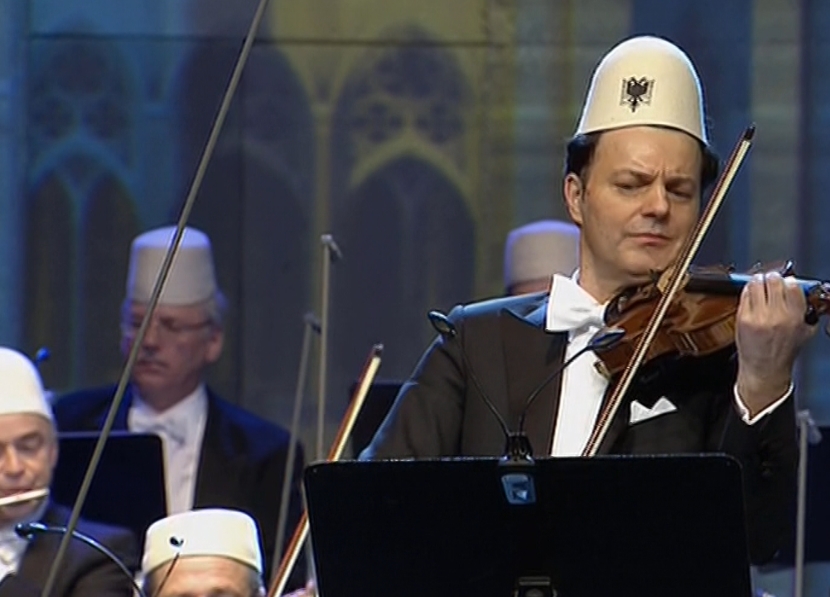
Performing the famous Strauss ‘Blue Danube’ waltz, Austrian artists wore Albanian traditional hats and drank raki alcoholic drinks in their debut Tirana concert with ShkelzenDoli, an Albanian-Kosovo Vienna Philharmonic violinist who entertained Albanians with his private Philharmonic Ensemble Vienna band.
The much-expected concert came to Tirana on Jan. 2, only one day after the Albanian violin virtuoso performed with the world famous Vienna Philharmonic Orchestra as a second violin. Thirty-six Austria-based artists joined the Philharmonic Ensemble Vienna, a band established by ShkelzenDoli in 2013, to perform in Tirana in a concert that Doli described as “bringing to Albania for the first time native pearls of Austrian art to wish all Albanians a happy and harmonious year.”
Italian 20th century masterpieces land in Tirana
Masterpieces of Italy’s 20th century art have landed in Tirana in one of the most special exhibitions Tirana’s National Art Gallery has hosted along with the 2010 showcase of some of greatest global masters such as Picasso, Warhol, Clemente and Chagall.
Amid paintings, sculptures, watercolors and sketches, the exhibition curated by Italy’s Arianna Angelelli and Maria Catalano of Rome’s Modern Art Gallery and Federica Pirani, traces the early 20th century art in Italy with its roots in Rome.
Wonderful women portraits, famous people, still life, landscapes, views from the Eternal City and Roman lowlands inspired great 20th century Italian artists such as Balla, Carrà , De Chirico, De Pisis, Capogrossi to create some of the Italian art masterpieces, part of Rome’s landmark Modern Art Gallery, says the Italian Institute of Culture in Tirana.
February
Albania bids adieu to one of its greatest writers
Albania bid adieu to DriteroAgolli, one of the country’s greatest modern writers and poets who passed away at the age of 85 following chronic lung and heart problems.
Artists, fans and politicians came together to pay tribute to the writer, considered a legend both under communism and during Albania’s transition to democracy after the early 1990s at a ceremony at Tirana’s Palace of Congresses building where he appealed for the reformation of the former Labour Party in 1991 as the communist regime was collapsing and had many of his poems turned into songs in festivals held there.
A writer, journalist and politician, Agolli has been one of Albania’s most distinguished public figures, boasting 65 years of creativity starting from the late 1940s when he wrote his first poems as a seventh grade elementary school student.
Ermal Meta grabs three Sanremo awards
Ermal Meta finished third in Italy’s prestigious Sanremo music festival and also grabbed the Critics and Best Cover awards, making history as the first Albania-born artist to achieve this.
The Italy-based 35-year singer-songwriter came third in the 67th Sanremo edition with his “Vietatomorire” (Forbidden to die) ballad pop song as an appeal to say no to domestic violence. “I dedicate this song to my mother who taught me to disobey to every kind of violence. The song is a hymn to life. One should confront life face-to-face,” Meta told Italy’s Ansa news agency.
Meta, who left Albania and his hometown of Fier at the age of 13, performed with several bands in Italy and wrote songs for several famed Italian artists before embarking on a solo career in 2013.
March 2017
A decade on, ‘Internationals’ launched in English
“There is a misunderstanding that ‘Internationals’ is a book against the international community, I have received both compliments and criticism by foreigners,” said writer YlljetAlià§ka at a ceremony on the republication of his much-rumored book a decade after its launch.
“Without help by the international community, it would be difficult for Albania to go through transition to democracy in the early 1990s,” Alià§ka, a former diplomat and scriptwriter, told an audience of writers, journalists and art lovers at an event on the book’s republication by the Tirana Times publishing house.
The Tirana Times publishing house launched the book in English translated by June Taylor, and also republished the book in its Albanian and French versions.
“Having the book republished after a decade is a sign of appreciation for every writer. The topic is still current with the presence of the international community, clichà©s and misunderstandings. The internationals’ universal systems often do not match the complex Albanian reality,” said Alià§ka.
The book is considered an effort to demythicise everything coming from abroad, often compared to idolatry most Albanians displayed against communist leaders under communism which banned religion for more than two decades, turning then-Stalinist Albania into the world’s first official atheist country and isolating the country into what has been described as Europe’s North Korea.
April
Sazan island opens up to tourists
As Albania geared up for its 2017 tourist season and hopes to make one of the country’s most promising industry a year-round enterprise, authorities are also opening up key military facilities to tourists.
The Sazan Island, a military base in southern Albania managed by the defense ministry was first used by the Italians until World War II before becoming the country’s most secretive base under communism when it was fortified with bunkers and tunnels designed to withstand a possible nuclear attack that the Albanian communist authorities feared.
The Sazan Island, which initially opened to foreign tourists in 2015 for the first time in 70 years, was made available for scheduled visits for six months from May 1 until the end of October.
The tiny now uninhabited 5.7 km2 island and the Karaburun peninsula form the first and only national marine park of Albania.
The marine park features ruins of sunken Greek, Roman and World War II ships, rich underwater fauna, steep cliffs and giant caves, ancient inscriptions of sailors on shore, secluded beaches, and breathtaking views of the coastline.
550th anniversary of Madonna of Shkodra saving
A Virgin Mary icon dating back to the 19th century which survived the communist persecution and atheism for almost five decades has been finally restored and placed at the St. Stephen Cathedral in Shkodra, northern Albania. The restoration also commemorated the 550th anniversary of the miraculous arrival of the original oil painting of the Madonna of Shkodra at Italy’s Madonna of Good Council Church in Genazzano after the Albanian sanctuary was destroyed by the Ottomans in 1467.
Cardinal Franc Rodà©, who was Pope Francis special envoy at the celebration, urged Albania to continue its religious co-existence model.
“Albania will never die of chill because it preserves its historical memory, its legends and cultural and spiritual identity,” said Cardinal Rode who blessed the recreation of the original 5th century painting that long resided in Shkodra until the 15th century Ottoman occupation.
Shkodra archbishop Angelo Massafra said the restoration was also a symbol to restore a people’s conscience.
May
‘Occurrence in present tense’ launched at Venice Biennale
“Occurrence in present tense,” a project by Albanian contemporary artist Leonard Qylafi curated by Austria’s Vanessa Joan Muller represented Albania at this year’s international art exhibition of the Venice Biennale where painter turned politician, Albania’s Prime Minister Edi Rama and his long-time collaborator, Albanian-French artist AnriSalawere among those selected for the main “Viva, Arte Viva” exhibition.
Albania’s Culture Minister MirelaKumbaro said the Albanian pavilion represents the tough past the country has been through, serving as a basis for the future.
A Tirana-based Albanian contemporary artist, Leonard Qylafi, 36, works in different mediums including video, photography, music and painting.
‘House of Leaves’ opens up as remembrance museum
A downtown Tirana facility that housed for a short time the notorious Gestapo Nazi secret police during the country’s occupation under WWII and was the interception headquarters of the Sigurimi secret service under communist for more than four decades until the early 1990s, was transformed into a museum of secret surveillance, showcasing one of the country’s darkest periods to the younger generations and foreign tourists.
“The ‘House of Leaves,’ initially built as a small maternity hospital in the early 1930s, is a building that was set up as an obstetrics clinic to bring to life, but was in fact used to take people’s lives,” said Culture Minister MirelaKumbaro at the museum’s opening ceremony this week.
Late Albanian translator and author AmikKasoruho who was sentenced to 10 years in prison in the early 1950s over agitation and propaganda activity against the communist government, said the “museum is dedicated to the innocent who were intercepted, spied on by the communist regime, and as a result arrested, interned, imprisoned executed and suffered lots of other severe punishment.”
The museum features the totalitarian control and its presence everywhere through interceptions in the form of pars pro toto, a part or aspect of something taken as representative of the whole, through authentic and replica interception items and materials.
A report by the Institute for the Study of Communist Crimes has unveiled the 45-year communist regime that collapsed in the early 1990s imprisoned or interned for politically motivated reasons more than 90,000 people, of whom about 7,000 were killed or died of tortures.
June
Tirana’s landmark Skanderbeg square gets facelift
Tirana’s landmark Skanderbeg square was given a facelift under a €13 million government-funded project that completely transformed the most important public space linked to a number of historical events and manifestations from King Zog’s reign until WWII to the communist takeover and the early 1990s protests for democratic changes.
Designed by a Belgian studio, the square is an old project dating back ten years ago when current Prime Minister Edi Rama was Mayor of Tirana.
The new square named after the country’s 15th century national hero is 90,000m2 space, of which 28,000m2 in stone collected from Albanian-speaking territories and another 32,000m2 of trees, bushes and decorative flowers. The square also showcases some 100 water fountains in its stone area, serving as an oasis in hot summer days. An underground parking lot with a capacity of 358 cars has also been made available to somehow settle the capital’s parking stress.
Tirana Mayor ErionVeliaj said the square which he described a symbol of unity is now the Balkans’s largest pedestrian area.
July
‘Wall’ installation commemorates 1990 embassy exodus
The cabin of a former Czechoslovak LIAZ truck used to smash the wall of the German embassy in Tirana in 1990 when thousands of Albanians entered the embassy to seek asylum and protection from the communist authorities has been immortalized in an installation commemorating Albanians’ embassy exodus 27 years ago.
“The Wall” is an installation created by Albanian civil society activists and artists GjergjIslami, Ana Pekmezi and EljanTanini that has been placed in backyard surrounding wall of the German embassy in Tirana exactly where 27 years ago on July 2, 1990 Albanian driver YlliBodinaku broke in.
Bodinaku, in his 30s at that time, used his state-run enterprise LIAZ truck to smash the German embassy wall, opening a crack that provided refuge to more than 3,000 Albanians who were later granted asylum and taken to Germany.
The 60 year-old man who lived in Germany for three years before returning to work in a car service in Tirana, says the installation is very special as it recalls history and the first anti-communist protests before the December 1990s student protests paved the way to the collapse of the communist regime, one Europe’s harshest led with an iron fist by late Stalinist dictator EnverHoxha.
A British director’s documentary on Albanian iso-polyphony
Young British filmmaker Dan Shutt picked the Albanian iso-polyphony to shoot his first documentary.
A sophisticated form of group singing, performed mostly by men in southern Albania, the Albanian iso-polyphony, is recognized by UNESCO as Masterpiece of the Oral and Intangible Heritage of Humanity.
Dan Shutt’s ‘Washed by the Moon’ is a documentary exploring the ancient tradition of Kà«ngà« Labe, an ancient singing style unique to southern Albania, through the lives and stories of its legendary musicians.
With filming already in its final stage, the documentary is set for release at international film festivals from March 2018.
In an interview with Tirana Times, the young director says is he is optimistic ‘Washed by the Moon’ will hopefully play a part in bringing iso-polyphony to the international audience.
“Iso-polyphony, and specifically Kà«ngà« Labe, which is still practised in the southern part of Albania, has rightly been declared unique by UNESCO. Musically, it is astonishing, but it also carries huge social significance and a strong spirit of community,” says Dan Shutt, a young British filmmaker and journalist based between London and Berlin who has recently set up his own production company.
First two Albanian natural sites get UNESCO protection
The first two Albanian natural sites have received UNESCO protection as an extension of the World Heritage site of the Primeval Beech Forests.
UNESCO’s World Heritage Committee has inscribed Albania’s Gashi River and Rrajce, two locally protected areas, on the World Heritage List as an extension of the World Heritage site of the Primeval Beech Forests of the Carpathians and the Ancient Beech Forests of Germany.
Albanian experts who worked on the UNESCO application had described the newly inscribed areas as the last ‘islands’ of virgin woods remaining in Albania where 10-year wood cutting moratorium has been in place since 2016 in bid to protect remaining woods after decades of illegal logging and clearing for agriculture.
The Gashi River is located in northeastern Albania in the border zone with Montenegro and Kosovo in the area of the European Green Belt.
Rrajca is located in the upper Bustrica valley within the borders of Shebenik Jablanica National Park in the north-eastern part of Librazhd in the Elbasan region, central Albania.
October
Robert Elsie’s last wish comes true
Robert Elsie’s last wish was finally fulfilled. The famous Canadian-German who dedicated his life to Albanian studies will rest in Theth amid the Albanian Alps, a place which he loved so much and also dedicated a book calling it Albania’s rugged Shangri-La, a fictional valley as described in a novel by British author James Hilton.
Elsie, who died at 67 of the rare motor neurone disease, was given his last farewell at a ceremony at the National Library in Tirana before being buried in Theth, northern Albania.
Born in Canada and having studied and worked in Germany, Elsie’s first contact with Albania came in the late 1970s when the Linguistics Institute of the University of Bonn had rare and privileged contacts with the then-hermetic “People’s Socialist Republic of Albania” which he visited for several years.
Probably his most ambitious literary publication was the English translation from the northern Albanian Gheg dialect of the great literary epic of Father GjergjFishta (1871-1940), The Highland Lute: The Albanian National Epic, London 2005, a work in thirty cantos and 15,613 lines. The revival of this epic, long banned under the communist regime, was received with great enthusiasm, in particular in northern Albania.