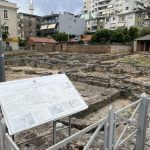
The third-century mosaic, also known as the “carpet of Apollonia” was discovered in 1959 by a joint Albanian-Soviet Union expedition
TIRANA, August 9 – An ancient mosaic discovered in the archaeological site of Apollonia 50 years is being restored, the Institute of Monuments of Culture has said.
The third-century mosaic, also known as the “carpet of Apollonia” was discovered in 1959 by a joint Albanian-Soviet Union expedition. The restoration of the 30 m2 mosaic with geometrical motifs is expected to finish by next September.
Since 1980 the mosaic has been on display at the premises of the National Historical Museum in Tirana.
Restorers say the best place for the mosaic’s display is the national park of Apollonia.
The vestiges of the grand city of Apollonia are about 8 kilometres/5 miles from the south-western town of Fier.
Founded, according to ancient writers, by Greeks from Corinth and Corfu in 588 B.C, it later became a Roman city, siding with Julius Caesar in the civil war with Pompey. It flourished until the third century A.D, when an earthquake changed the path of the Vjosa River. The harbour dried up and the city declined. By the 13th century, after the city’s swampland had expanded, resulting in outbreaks of malaria, the city’s residents had moved elsewhere. Over time, movements in the earth buried the city.
Austrian archaeologists began to excavate during World War I, a process that continues today; it is believed that most of the city is still deep below Apollonia’s hills.
Among the most striking remains are the six columns and facade of the Monument of Agonothetes (once part of the city’s administrative centre), from the second century A.D and the Odeon, a 300-seat theatre where the Roman Emperor Augustus studied in his younger days (today, it is occasionally the setting for concerts). The 13th century Monastery of St. Mary keeps the past protected, housing statues and other artifacts discovered in the process of excavation.