Culture Ministry officials say the Roman Baptistery mosaic, one of the largest in the Balkans, will reopen to visitors after remaining closed for several years
TIRANA, May 8 – The national park of Butrint, a UNESCO World Heritage site since 1992 situated in southernmost Albanian district of Saranda, will offer a series of new services to its visitors during this year. Apart from the e-ticketing service launched last summer, the Butrint Park will also offer audio guides, wireless internet and a surveillance system, says the Ministry of Culture and Tourism after a meeting of the park’s board in recent days.
The audio guide in English and Albanian, prepared by the Albanian Heritage Foundation in collaboration with the Butrint National Park and the Butrint Foundation, will be available for visitors who prefer visiting the site on their own.
Ministry officials say the Roman Baptistery mosaic, one of the largest in the Balkans, will reopen to visitors after remaining closed for several years. Constructed in the early 6th century, the Baptistery was discovered in 1928 by the Italian Archaeological mission. It is the second largest baptistery in the Eastern Roman Empire, the largest being that of Hagia Sofia in Istanbul. The intricate brightly coloured mosaic has representations of land (animals), air (birds), and water (fish), symbolizing aspects of Christian salvation.
The national park will also host archeology, conservation and anthropology training courses in cooperation with the U.S universities of Notre Dame and Utica College.
Data show some 4,000 people, mostly foreigners, visited Butrint park during the first four months of 2013.
Park officials plant to plant 700 trees and make available 50,000 leaflets for visitors to Butrint during this year.
Butrint park
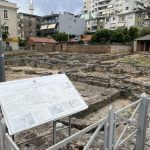
Inhabited since prehistoric times, Butrint has been the site of a Greek colony, a Roman city and a bishopric. Following a period of prosperity under Byzantine administration, then a brief occupation by the Venetians, the city was abandoned in the late middle Ages after marshes formed in the area. The present archaeological site is a repository of ruins representing each period in the city’s development.
Excavations carried out by Albanian and foreign expeditions continue shedding light on the ancient settlement. In 1992, Butrint was designated as a World Heritage Site – a status that identifies cultural and natural sites of outstanding universal value.
The National Park was established in 2000 affording Butrint full protection within Albanian law. The original 26 sq km of the park boundaries were in 2005 expanded to 86 sq km.
The amphitheatre, dating from the 3rd century BC, bears witness to the cultural riches of the city the stone banks of seating, of which 23 rows have been preserved, would have held an audience of 1,500. The theatre is situated at the foot of the acropolis, close by two temples, one of which is dedicated to Asclepios, the Greek god of medicine, who was worshipped by the city’s inhabitants.
Excavations have brought the light to many objects – plates, vases, ceramic candlesticks – as well as sculptures including a remarkable ‘Goddess of Butrint’ which seems to completely embody, in the perfection of its features, the Greek ideal of physical beauty.
Butrint is not just famous for its physical cultural heritage – it is also a natural environment of international importance. The Park contains a wide variety of habitats – coastal wetlands, saltwater lagoons, rivers and open grazing lands, which are home to many rare birds, insects, amphibians, mammals and reptiles and in 2003 it became a Ramsar Wetlands Site of International Importance. Butrint is the richest site for bio-diversity in all of Albania and the Park shelters 26 species of global conservation concern, such as the marginated tortoise, the wolf and the white-tailed eagle, according to the Butrint Foundation.