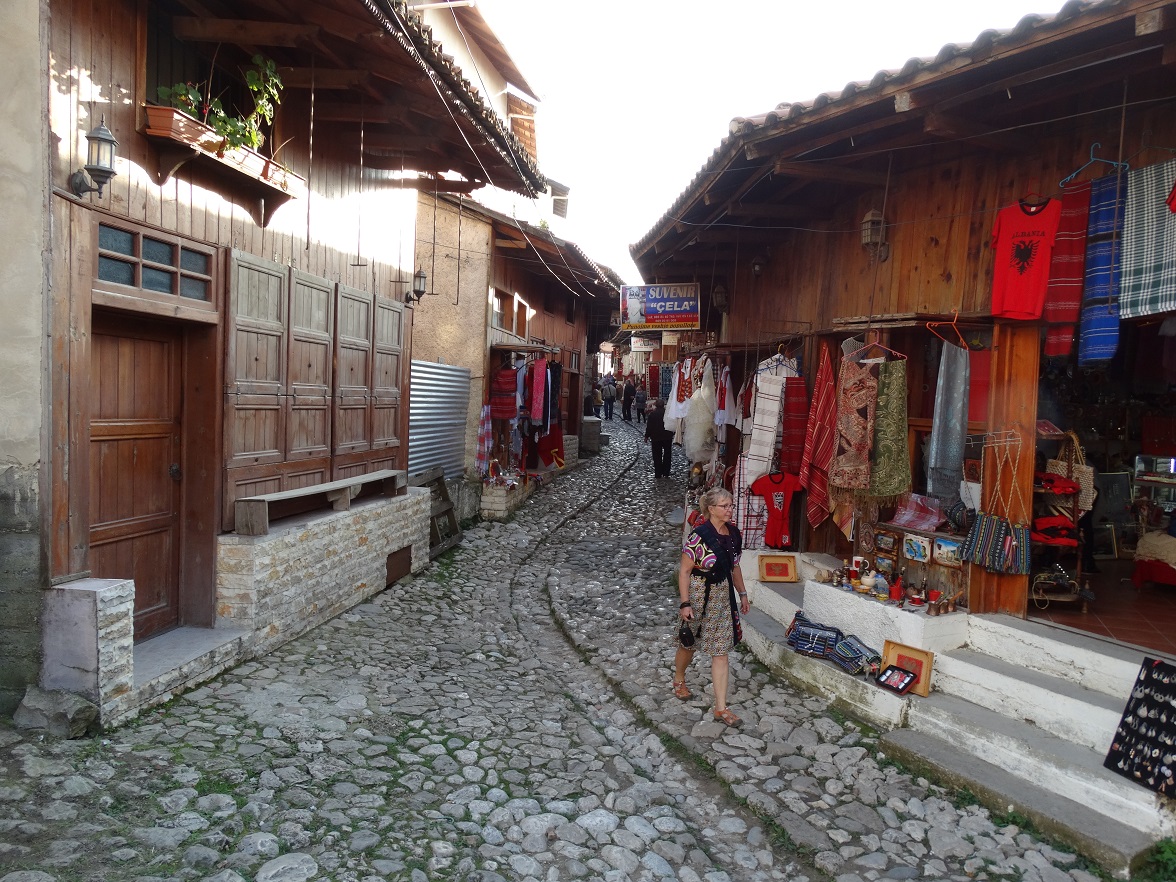
 Historically the Kruja bazaar, some 37 km off Tirana, has always been a lively and vibrant melting pot of artefacts, tradition, fabrics, colours, food, skills, architecture and people which altogether made this place so special.
Although much has changed in the past decades, the artisans in Kruja still work here and they represent the backbone of the bazaar. Their golden hands have the capacity to recreate and reinterpret centuries of history and cultural heritage and turn it into beautiful artisanal products.
That is how a guide called Artisans of Kruja, describes the characteristic local bazaar in Kruja, a town known as the stronghold of Albania’s 15th century national hero, Skanderbeg.
Thanks to a project funded by the American Albanian Development Foundation (AADF) and implemented by Cultural Heritage without Borders Albania (CHwB Albania the local bazaar infrastructure has been upgraded and the artisanship sector revitalized.
With the help of an international designer, Vesna Avarmovska, the artisans have created a unique line of products, which have a wide variety of forms and prices, attractive to both the local and tourist markets. The traditional products improved by advising the artisans on how to merge the historical techniques with modern methods. Moreover, a well experienced senior artisan, originally from Shkodra, Kristina Mjeda helped them to develop the new products; using new raw material; mixing textiles with other materials in order to create a unique combination of handicraft souvenirs, improving traditional techniques and monitoring the production phase.
“Artisans of Kruja” represents an important contribution to the revitalisation of the bazaar of Kruja, which AADF has recently invested in restoring. Besides the physical intervention, the creation of TID Kruja (Tourism Improvement District) has contributed towards the promotion of tourism and protection of cultural heritage in the city.
“Artisans of Kruja” believes that it contributed towards a unified and distinctive Albanian brand, which sapiently blends tradition and contemporariness, launching the new face of Kruja.
Idriz à‡ela
Head of the TID Kruja Board
“Tourism Improvement District” (TID Kruja) started operating in the beginning of 2016. Its goal is the promotion of traditional values that help support the development of the tourism sector in the historic centre of Kruja, for the benefit and interest of the local community. TID Kruja has also raised awareness and undertaken concrete actions to preserve the cultural heritage through the originality of local products.
From this perspective the collaboration with CHwB Albania has been fruitful in increasing the variation of products offered, raising the values of the bazaar and adapting handworks with contemporary needs.
Through similar initiatives, such as “Traditional Costumes Fashion Day” , or “Employment Incitement Program” (offered by the Ministry of Social Welfare and Youth), we want to increase the variety of products and services offered in the bazaar. We also hope to raise awareness so that the younger generation can come closer to the idea of artisanship and pass on this tradition from generation to generation.
Vesna Avramovska
Designer, marketing expert
I like the bazaar in Kruja very much. I admire the shops, products and craftspeople every time. What I tried to do while working for the project “Artisans of Kruja” is to focus on building up the trust in traditional values and products among the producers, shopkeepers and tourists.
Generally speaking, artisans need to have more confidence in the great craftsmanship they offer and also be more willing to take part in initiatives that can help them take the necessary steps towards the needs of the consumers. It is a long process, of course. One has to keep an open mind, be curious, experiment with new products and listen to the feedback of the customers. I’m confident that the artisans of Kruja are on the right track.
This is how I see the young generation playing an active role. There is a hidden treasure in the bazaar of Kruja, which can serve as a great inspiration for them. They must learn the traditional skills in order to make great designs which would be attractive for new customers. They are the ones that can bring some fresh air to Kruja.
With support of platforms such as the project “Artisans of Kruja” , I am sure that Kruja Bazaar will become a nice and welcoming spot. I imagine Kruja Bazaar as a place where traditional techniques are utilized in production of products for the tourist market and also for the needs of everyday living.
Kristina Mjeda,
Product developer, production expert
I believe that the bazaar in Kruja has unique values for our country because, besides its historic and architectural landscape, it is enriched by the talented artisans working there.
Based on my experience as an artisan and as a businesswoman I think that the bazaar is on the right path towards further development, through which it will be able to better accommodate the needs of an ever-changing market.
In this perspective I think that the “Artisans of Kruja” project, implemented by CHwB Albania, has been very fruitful for the artisans. We have created close relationships among each other. I have tried to transmit four generations of my family’s experience with artisanship and I take back from the artisans a great amount of commitment and desire to improve their standing in the market.
The young generation has a big role in this aspect. Their inclusion would be a guaranteed success as they are the most appropriate to bring the needed changes in the bazaar.
I believe that this will happen in the near future. Also, I wish the artisans to be successful and to represent their tradition according to the contemporary trends in the best way possible. I wish the work we have done through this project to serve as a basis for the artisans to take steps towards the future that we all aspire to.
Arjana Cerhozi
Kilim maker
It was my mother’s passion that first introduced me to the loom at the age of 14, in the former Artistic- handmade enterprises. Once you’re taught a craft you never forget; that is why for the past 35 years it is all I have done. We have always produced handworks, but since 2005 we’ve had a constant business in this.
In my workshop I give importance to hosting the clients. They can’t imagine our handwork until they see us working on the loom. Once they do, they’re amazed at how this can all be done by hand.
We regularly have students visit our workshop and when they see us working they remain quite shocked. Often they come and go without ever trying to work on the loom themselves. I’d be very happy to teach them just for the pleasure of passing on this tradition. When I get to talk to them, I tell them about a 70 year old lady that comes from Kavaja to Kruja just to learn how to weave on the loom.
The “Artisans of Kruja” project gives us the opportunity to deepen our knowledge and I wish the next generation to follow this example as we are the last to continue this tradition. I hope the involvement of the younger generation will prevent this beautiful craft and this ancient tradition from vanishing.
Xhevdet Bardhi
Kilim maker
For 26 years now we have produced and sold kilims, entirely handmade in Albania, from the woolen thread, to its colors. It is not an easy job. We don’t just simply sell objects; our products are a reflection of the cultural heritage of our city and our region.
It is the crafts, the artisans, the rugs, the kilims, the table cloths and the woven scarves that attract people towards Kruja. A product bought in the bazaar, with its patterns, symbols and different models, represents a tradition that goes back hundreds of years.
Our greatest obstacle is that we are slowly loosing the last generation of artisans that know how to weave on the loom, which is why it is important to attract the younger generation towards this tradition. I am sure that those who learn will love it, just as we do, and they will be very successful.
The project Artisans of Kruja” helped us to move towards the future by bringing a larger variety of products in a way that appeals to contemporary standards.
Ndrià§im Guni
Qeleshe maker
In our family, felt working is a tradition passed on from generation to generation. In the beginning it was my grandfather, then my father, me and now my son. I remember when my father would make me learn this craft at the age of 20. In the beginning I was not attracted to it, but with time the will of our ancestors had its weight on me. Now I have been able to include my son in this tradition and I look forward to the day that I can teach my grandchildren.
It is hard work that requires a lot of sacrifices and every member of the family and every room of our house are included in it. Despite the long effort, every process is important and beautiful to me, but I’d like to emphasize working with the qeleshe, the Albanian traditional white felt hat, which is the basis of our craftsmanship.
Eelida à‡ela
Traditional costumes
I come from a simple family and out of four sisters I was the only one to inherit this tradition from my mother. When the bazaar was open to private businesses, we opened this small shop. At first we were selling antiques, but as the interest for our beautiful tradition of handmade national costumes grew, I came back to artisanship. To me it is more than an everyday job, it is an immeasurable wealth.
I find it to be a very beautiful craft that preserves the past and I enjoy working very much, but it requires a great amount of passion. Before they would teach us hand working at school and I still remember the teacher that taught me embroidery.
I am happy to see art or textile students coming and asking for details of the process of creating a traditional costume and I wish I had a group of students I could teach, in order to prevent us from loosing this tradition. For those that love beauty and working independently, this type of job is very rewarding.
The “Artisans of Kruja” project has given us great ideas. Besides our continuous work with consultants I’d emphasize the importance of the business trips we had in Greece, Bosnia and Macedonia . Meeting the local artisans, talking with them, visiting their work spaces and their shops has inspired us to start developing new products and undertaking small improvements in our shops.
Lindita Herri
Embroiderer
I first started working with embroidery in 1981, first as a student for six months and then as an employee. When the political system changed, so did the work structure, so my husband and I started working with traditional costumes.
The work is very attractive and we do it with great passion. Personally, I believe that weaving traditional costumes is a thing of great beauty. Each day we get a different request and everything we do we adapt it to our customers, while preserving our old tradition.
Kruja has a lot of visitors, Albanian, foreigners, kids, youngsters. They all like embroidery, but no one seems to be interested to start working, as it seems too difficult. It would be very good if we managed to attract the young generation towards artisanship. I believe that this moment will come in the future, when we’ll be able to transmit our old tradition.
I would love to pass it on, together with all its secrets and tricks.
The “Artisans of Kruja” project has been a great impetus by opening new perspectives to us. We have worked hard on the new designs and many of them have been successful.