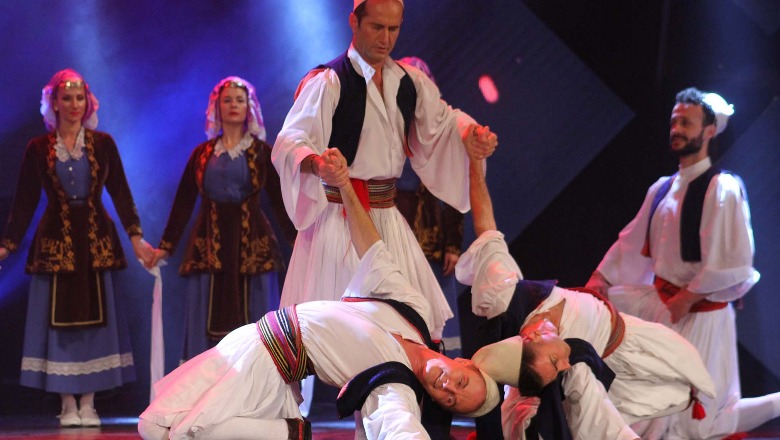
TIRANA, April 25 – Albania presented its diverse choreographic culture of colors, rhythms and energy stemming from an established European identity in Brussels’ Bozar Hall days after the European Commission unconditionally recommended accession negotiations to open for the country.
The National Songs and Dance Ensemble was invited to participate in the international cultural festival Balkan Traffic, taking place from April 19 to April 22.
Its representation included a team of 17 artists – soloists, dancers, vocal singers, an orchestra and a polyphonic group led by singer Hysni Zela – who took the audience traveling through a variety of songs, dance and Albanian folklore.
Parts of the program were some of the country’s most renowned dances based on the area of origin, polyphonic songs and traditional orchestral pieces of music or melodies stemming from some of the country’s oldest songs.
Minister of Culture Mirela Kumbaro has previously said that cultural diplomacy is an integral part of the country’s image overseas.
“Culture’s role in the improvement and promotion of the country’s image is essential. It has been years that Albania’s been exporting high-quality culture,” Kumbaro has said.
The National Ensemble, recently awarded with the National Honor title, came out successful from this major cultural event in the European capital.
Artists decided to dedicated this edition to the country’s poliphony as part of the UNESCO heritage, in the context of Albania’s 60-year UNESCO membership anniversary.
Originally proclaimed in 2005, folk iso-polyphony was inscribed in 2008 on the Representative List of the Intangible Cultural Heritage of Humanity and recognized by UNESCO as a Masterpiece of the Oral and Intangible Heritage.
Derived from Byzantine church music, Albanian Iso-polyphony is a sophisticated form of group singing, performed mostly by men in southern Albania. The rise of cultural tourism and the growing interest of researchers are contributing to the revival of this unique folk tradition.
The Albanian polyphony is a type of traditional vocal music specific to southern Albania and is by far the most popular form of folk music in this part of the country. In the Laberia region it is normally sung unaccompanied by instruments and is often improvised by two or three lead singers who set forth the melody and text. The other singers accompany the lead singers as a chorus with a so-called iso, a drone at a constant pitch.
The Albanian Ensemble was supported by the country’s Ministry of Culture, in cooperation with the Ministry for Europe and Foreign Affairs and the Albanian diplomatic representation in Brussels, Belgium.