A luxury resort project linked to Jared Kushner has ignited nationwide protests now demanding the government’s resignation.
Tirana Times, June 03, 2026 – A luxury tourism project linked to Jared Kushner has turned a local land dispute on Albania’s southern coast into a national political crisis, triggering mass protests that are now calling for the resignation of Prime Minister Edi Rama’s government.
The conflict centers on Zvernec, near Vlora, inside the wider Vjosa-Narta protected landscape, one of Albania’s most sensitive coastal ecosystems. The planned development has been publicly linked to Kushner, the son-in-law of U.S. President Donald Trump, Ivanka Trump and Qatari investors. It has also drawn scrutiny because of disputed land titles, unclear ownership structures and the involvement of powerful domestic business interests.
The crisis escalated after masked private security guards clashed with local residents and environmental activists near the disputed site. State police were present, but many protesters say they failed to intervene decisively. The images quickly became a symbol of a deeper grievance: the belief that private power, when backed by political connections and international names, can operate above public accountability.
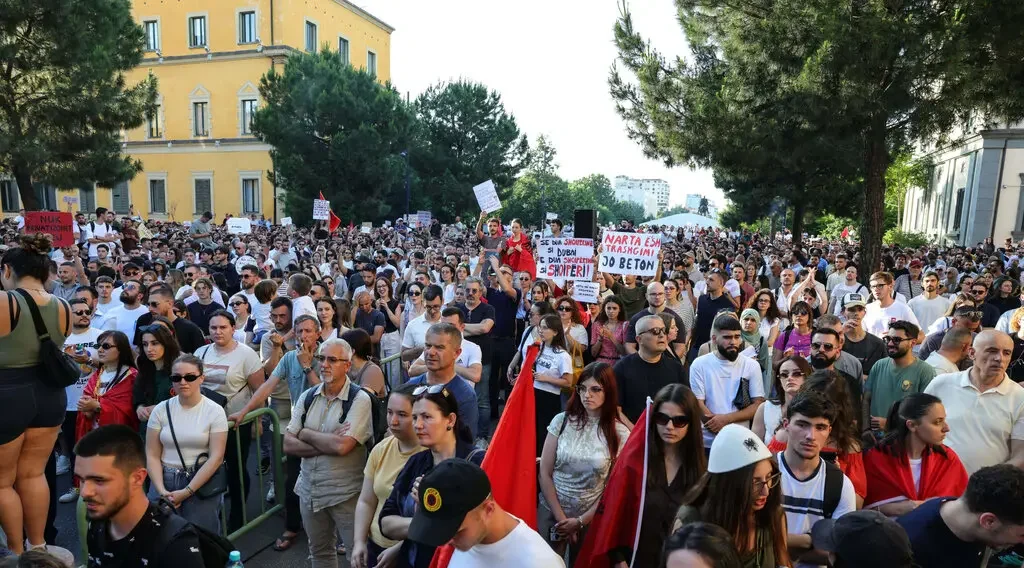
Within days, protests moved from Zvernec and Narta to Tirana. Thousands gathered in the capital, calling not only for the cancellation of the project, but also for the repeal of Albania’s strategic investment law, the scrapping of other controversial development packages and the resignation of the government.
This is what makes Zvernec politically explosive. The protests are no longer only about a resort. They have become a vehicle for wider anger over corruption, land disputes, weak institutions, environmental protection and the perceived arrogance of power.
A protest beyond the opposition
One of the most striking features of the movement is that it does not appear to be led by Albania’s traditional opposition. Protesters have targeted both Rama and former Prime Minister Sali Berisha, reflecting a broader rejection of the country’s political establishment.
That makes the movement harder to dismiss as a routine opposition campaign. It also makes it harder to control.
The anger is especially visible among young Albanians. For many of them, Zvernec is not just a protected coastal area. It is a symbol of a system in which beaches are fenced off, inherited property remains unresolved, public space is privatized and opportunity is captured by those close to power.
The debate has also produced a wave of conspiracy theories. Some have suggested Greek influence. Others have pointed to anti-Trump forces, Islamist circles, Russian interests, Soros-linked networks, European pressure or even internal games within the ruling elite.
But such theories miss the central point. The protesters had concrete reasons to take to the streets: contested land, private security, lack of transparency, violence against residents and the sense that no institution was willing or able to defend them. Before searching for a hidden foreign hand, it is necessary to look at the indignation of the young people who turned the boulevard into what one commentator called a “return of democracy.”
The Kushner project and the rule-of-law test
Rama has defended the project as part of his vision for high-end tourism. He argues that Albania needs large investments to move beyond low-value seasonal tourism and attract global capital, international brands and wealthier visitors.
The government says investors have followed Albanian legal procedures and that property disputes should be resolved by courts and prosecutors, not by planning authorities.
But critics say that is not enough. A project of this size, in or near a protected area and on land with contested ownership, cannot be treated as a private negotiation between government and investors. It requires full transparency before development moves forward.
For nearly two years, the government said little publicly about the project. That silence is now part of the controversy.
“It is very surprising that an investment project worth around four billion euros was kept almost secret for such a long time,” one local analyst said. “Meanwhile, someone made sure to spread the message that this was the project of the son-in-law of the president of the United States. Citizens also saw Ivanka Trump visiting the area accompanied by the prime minister. This may explain why the state police stood by and did not intervene when masked private guards dragged protesters away.”
The ownership issue remains the most sensitive part of the case. Local residents say inherited land has been included in the project without final resolution of long-running property conflicts. The area has for years been linked to contested titles, court decisions, criminal proceedings and allegations of forged documents.
SPAK, Albania’s Special Anti-Corruption Structure, has opened investigations into suspected property alienation and procedures linked to the project. On June 2, it reportedly imposed preventive seizures on bank accounts of Albania Land Development, a company linked to Qatari businessmen Moutaz and Ramez Al-Khayyat, who have been mentioned as part of the investment plan with Kushner.
That moved the case from political controversy into the justice system. The key question is whether the land behind one of Albania’s largest proposed tourism developments was consolidated on a clean legal basis or through contested ownership chains.
The environmental dimension is equally important. Vjosa-Narta is a fragile coastal ecosystem with lagoons, migratory bird habitats and high biodiversity. Environmental groups argue that large-scale tourism development could cause irreversible damage.
The controversy also reflects a wider debate over Albania’s 2024 changes to the law on protected areas, which opened the door to high-end tourism projects in areas previously more strictly protected. Supporters say the changes allow controlled development. Critics say they have created a legal pathway for politically connected projects in some of Albania’s most valuable natural spaces.
Greece enters the dispute
The Zvernec case has also acquired a diplomatic dimension after reports that one of the injured protesters held both Albanian and Greek citizenship. Greece’s Foreign Ministry expressed strong concern over the May 30 incidents in Zvernec and said the Greek Embassy in Tirana had offered consular and medical assistance to the injured citizen. Greek media and political actors then linked the incident to broader issues of property rights, minority protection and Albania’s rule-of-law obligations on its path toward the European Union.
Albania’s Ministry for Europe and Foreign Affairs responded by expressing regret over the confrontation but stressed that the case was being handled by law-enforcement authorities. It said police had identified and arrested one private security employee accused of violence against a protester with Albanian and Greek citizenship, while two other employees faced criminal proceedings.
The exchange soon became political. Former Greek Prime Minister Alexis Tsipras, through his new political formation, criticized the handling of the incident and framed it as a matter involving property rights, minority protection and Albania’s European standards. Rama responded publicly to Tsipras, accusing him of helping turn what he called an isolated incident into a broader political and ethnic issue. Rama argued that the confrontation had occurred in a climate of tension and disinformation, and said the investors were operating on private land acquired, according to him, in compliance with Albanian law.
Tsipras rejected the charge of nationalism, invoking his record in the Prespa Agreement with North Macedonia and arguing that defending the safety and property rights of ethnic Greeks in Albania was a legitimate obligation for any progressive politician. He also linked the treatment of the Greek minority to Albania’s EU accession prospects. (
The diplomatic dispute added another layer to the crisis. Rama has rejected attempts to present the Zvernec incident as evidence of an anti-Greek policy by the Albanian government. A senior expert at the Albanian Institute for International Studies said the issue should not be read as a minority dispute.
“No such policies exist,” the expert said. “But the barbaric images from Narta, where private guards act in front of the state police and protesters are dragged away, show a flagrant violation of the law and of the rule of law.”
According to the same expert, the comparison with the Beleri case is useful only up to a point. In both cases, the core issue is not an official anti-Greek policy, but the weakness of the rule of law, contested judicial processes, property disputes and the problematic use of state institutions.
That distinction matters. If Zvernec is framed only as a Greek minority issue, the broader Albanian problem is obscured. The deeper issue is whether citizens, regardless of ethnicity or citizenship, can rely on the state to protect property rights, public space and legal order when powerful private interests are involved.
Albania needs foreign investment. It needs large projects that create jobs, attract capital and raise the quality of tourism. But strategic investment cannot become a parallel legal order.
A project can be economically important and still politically dangerous if it advances through secrecy, disputed land, weak transparency, private force and delayed public explanations.
Zvernec has now become more than a local protest. It is a test of whether Albania’s strategic investments will be governed by law, public interest and European standards — or by the opaque convergence of political power, private capital and international influence.
The question is no longer only whether the resort will be built. It is whether the government can still convince citizens that development in Albania serves the public interest, not just the powerful.