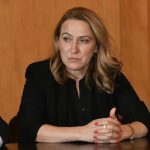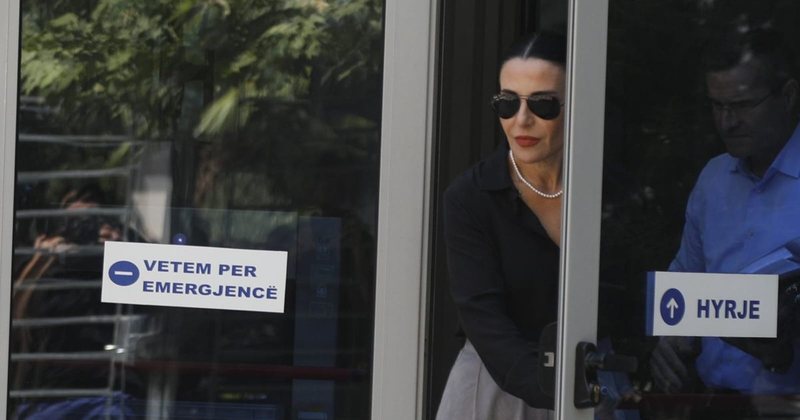
Tirana Times, August 07, 2026 — Albania’s Special Prosecution Office Against Corruption and Organized Crime has brought new allegations against former Deputy Prime Minister Belinda Balluku, widening one of the most politically sensitive investigations since the country launched its justice reform.
Balluku appeared before the special prosecution office, known as SPAK, on Friday to be formally informed of additional accusations linked to several public procurement procedures. She was also questioned about the allegations and notified of further procedural actions.
SPAK did not identify the procurement procedures involved in the latest accusations, leaving unclear how many contracts are under scrutiny, their financial value or which companies may have benefited. But the announcement indicates that the investigation has expanded beyond the major infrastructure contracts already made public.
The new charges significantly increase the legal pressure on Balluku, who served as deputy prime minister and minister of infrastructure and energy and was considered one of the most powerful figures in Prime Minister Edi Rama’s Socialist government.
Balluku was already accused of violating equality in public tenders in connection with the procurement procedure for the Llogara Tunnel, one of the government’s most prominent infrastructure projects.
She has also been investigated over seven procurement procedures related to the construction of sections of Tirana’s Outer Ring Road. These include contracts for road segments, bridges and several lots of the capital’s external ring-road project.
The latest development suggests that prosecutors are examining a broader pattern of public contracting rather than a single isolated tender. That distinction is politically important because Balluku supervised some of Albania’s largest and most expensive infrastructure and energy projects.
The investigation now raises questions not only about individual procurement decisions but also about the system through which major public works were planned, awarded and monitored during her time in office.
SPAK has not publicly disclosed the evidence supporting the new accusations. It has also not said whether the latest allegations involve the same criminal offense as the Llogara Tunnel case or whether Balluku could face additional charges.
The case nevertheless represents an unprecedented challenge for the governing Socialist Party. Balluku is so far the highest-ranking Socialist official to face criminal charges and an expanding investigation into alleged high-level corruption and abuse involving public funds.
The investigation is particularly significant because Albania’s justice reform was created to ensure that prosecutors and courts could act against senior officials without political interference. SPAK’s mandate specifically covers high-level corruption and organized crime, areas that have long been viewed as central obstacles to Albania’s democratic development and European Union membership.
The Balluku case is therefore becoming a test of whether those institutions can continue their work when an investigation reaches the center of political power.
SPAK previously announced that Balluku was also under investigation over the alleged acquisition of a villa in the southern coastal village of Dhërmi. Prosecutors suspect that the property, valued at 145,000 euros, was provided by the company Eurocol in exchange for favorable treatment in a public tender.
According to the prosecution’s allegations, the ownership of the villa was concealed through a suspected money-laundering scheme involving additional transactions and third parties.
Taken together, the Llogara Tunnel case, the Tirana Outer Ring Road investigations, the property allegations and the newly announced procurement charges create a much wider legal picture than the initial investigation.
The central issue is no longer whether irregularities may have occurred in one tender. It is whether political authority, access to public funds and control over major contracts were exercised within the law and subjected to meaningful institutional oversight.
The case also exposes the difficult relationship between Albania’s political leadership and the institutions established to investigate corruption. Government officials have frequently praised SPAK’s work as proof that justice reform is succeeding. But the Balluku investigation has shown how political support for independent justice can weaken when prosecutors target one of the government’s most senior figures.
That contradiction carries particular weight because numerous former ministers, mayors and other senior officials have been investigated, prosecuted, tried or convicted in recent years. The number of cases has demonstrated that corruption is not limited to lower levels of public administration.
It has also made equality before the law a central political question: whether powerful officials are subject to the same standards as ordinary citizens, regardless of their wealth, public position or closeness to the governing leadership.
Before the latest accusations were announced, SPAK had sought measures against Balluku while she was still serving at the highest level of government. Prosecutors initially requested her suspension from office, but the government refused to remove her.
SPAK later asked Parliament to lift her immunity and authorize further legal measures. The Socialist-controlled parliamentary majority rejected the request. The uploaded material states that the majority voted down SPAK’s request in March.
The European Union has raised serious concerns over the handling of the Balluku case, viewing it as an important test of Albania’s commitment to the rule of law and the principle that everyone must be equal before the law, regardless of political power or economic influence.
The case now sits at the intersection of politics, public procurement and criminal justice. Its outcome will help determine whether Albania has established a real dividing line between government authority and the institutions responsible for investigating high-level corruption and organized crime or whether political protection remains stronger when an investigation reaches the top.