By Enrico Letta
Delivery as the defining challenge
Thank you. I am genuinely pleased to be here, and I will tell you why I rearranged my agenda to make it. When I saw the title of this event — “Proof, Not Promises”, I understood immediately that this is the title we need to put at the front of the door of every European institution right now. This is not rhetoric. It is the description of a change of speed that Europe requires, and that it has so far failed to achieve.
Delivery is the word you hear everywhere in Europe today. It is sometimes complicated to make it land anywhere concrete. But I can tell you this: if we fail to connect delivery with what we are doing at the European level, we will miss Europe. We will miss the European dream. Because across the continent, in member states and in candidate countries alike, the same question is being asked: is Europe capable of delivering? We are under pressure on that. We see countries and systems — democratic and less democratic — that appear to be delivering faster. And this perception of faster delivery outside Europe is weakening the internal cohesion of the European Union.
This is why the two reports — mine and Draghi’s — were necessary. And this is why 2026 is the year the implementation finally started. In February, the European Council invited both of us. In April, in Cyprus, the European Council approved the “One Europe, One Market” plan. The year 2025 was largely lost: European leaders spent it recalibrating their response to Trump’s second term, which turned out to be fundamentally different from the first. That recalibration took the whole year. Implementation began in 2026.
Why fragmentation is the enemy
I want to share some information that rarely breaks through the noise of geopolitics, wars, and immigration — and I say this because every time I repeat these numbers, I find that they are not as widely known as they should be.
Europe is 17% of world GDP. The United States is 25%. We play in the same economic league because we have the single market, the free movement of goods and people. But when it comes to finance, our 17% becomes 11% of world market capitalisation, divided across 27 separate markets. The American 25% becomes 60% of world market cap, because they are one market. The consequence of this divergence accumulates year after year.
Twelve years ago, the largest European bank was half the size of the largest American bank. Today, the ratio is one to eight. This is what financial fragmentation does — not in theory, but in practice, compounded over a decade.
Let me give you a smaller, daily-life example. When I was in Paris recently, I tried to purchase a public transport subscription online. It is impossible to do so without a French telephone number. Not a European telephone number — a French one. Any French consumer will pay with a French credit card; no French consumer will pay with a German one; and all of us, across the continent, are happy to pay with American credit cards. This is the single market we have built: one where the real beneficiary of fragmentation is the United States.
“In the world of China, India, the BRICS, and US finance and AI, we are all small countries — including those that have not yet understood this.”
When the single market was created at the end of the 1980s, Italy — 60 million people — was economically as large as China and India combined. Today, China and India are twenty times Italy. The same is true for France, Germany, and Spain. The psychological problem of Europe is that some of its countries have not yet internalised that we are all small now. The only path to security — economic security, financial security, technological autonomy — is to integrate.
“One Europe, One Market”: what has been decided
In April 2026, the European Council approved a plan. It is called “One Europe, One Market.” It is the application of the report I wrote, and it contains 42 measures.
Among those 42, several are decisive for the next phase. The Savings and Investment Union will integrate financial markets. The 28th regime will provide a simpler regulatory framework for cross-border activity, so that companies do not have to navigate 27 different sets of rules. The European Grid will address energy interconnection. And the Industrial Accelerator Act will do something Europe has never done properly: support companies in scaling up to become European champions rather than national ones.
On this last point, I want to be clear. Scaling up is not against SMEs. It is the precondition for them. A European champion creates the ecosystem in which smaller businesses thrive. Airbus succeeds because there is one Airbus, not 27 national aircraft manufacturers. The problem in Europe is that we are full of national champions, protected at the national level, that are not large enough to compete globally — and that are declining as our countries become smaller in relative terms.
I also propose what I call a fifth freedom: knowledge, intangible research, and skills. The original four — goods, services, capital, people — were designed for an industrial economy. The new economy runs on knowledge. Europe has extraordinary research capacity. It is fragmented, it is underfunded for cross-border collaboration, and it is losing talent to the United States at a rate that is structurally damaging. The fifth freedom is the answer.
“The single market is more than a market. The single market is full citizenship. It is not being an immigrant in your own European Union.”
The single market and the Europe of the future
I became convinced that what we are building is not a technical regulatory framework. I understood this fully only after a conversation with Jacques Delors — the architect of the single market — three months before his death in 2023. He gave me two pieces of advice.
The first was that the single market has a twin: cohesion policy. There is no single market without an effective cohesion policy. This was his cardinal point, and it became mine.
The second was: do not lock yourself in a building in Brussels to write this report. Go everywhere. Meet people. Because the single market means people.
He was right. In Lithuania, someone asked me to describe the single market in one image. I told them: I lived twice outside my country. Once in the 1970s, as a child in Alsace, when my father taught at the University of Strasbourg. We were a family of Italian immigrants. The second time was recently, when I brought my family to Paris. We were a family of European citizens choosing Paris instead of Milan. The single market is that difference. It is the difference between being an immigrant in your own continent and being a citizen of it.
Enlargement: what went wrong and what must change
For enlargement, the single market is not just a metaphor. It is the instrument. And I have advocated this in Brussels since the beginning, because if enlargement is perceived by citizens — in candidate countries and in member states — as something that happens in the clouds, among decision-makers, in chapters and benchmarks that have nothing to do with their daily lives, then you lose the meaning of Europe entirely.
There is momentum now. I see it. Brussels is beginning to understand that enlargement and the single market can be married — that the single market can become, even before formal accession, a part of the daily lives of people in candidate countries. That is how you stop the cycle of promises and no proof.
But I have to be honest about the mistake we made in the previous big enlargement. It was not that enlargement itself was wrong — it was a success. The mistake was structural: we built every relationship bilaterally, each candidate country with Brussels, and we did not oblige or encourage candidate countries to build relationships with each other. We would be satisfied if a country looked to Brussels and did not ask it to look at its neighbours.
“If we think we want to be with Brussels, but we do not like our neighbouring country, that is exactly the opposite of how we live in Europe.”
We are in danger of repeating this mistake. The remedy is to build working single markets among candidate countries — to create the single market mentality before accession, so that by the time membership arrives, the habit of cooperation is already established. This is why I put it at the centre of the report. And it is why I am here.
A civil society road map
We are organising a platform — the Jacques Delors Institute, universities, think tanks, civil society — to urge European leaders to move fast on implementation. Events in Rome, Bucharest, Paris, Stockholm, and Berlin by the end of this year. We are civil society, which means we are poor by definition. But I would like to extend this roadshow to candidate countries, because together we can build the pressure that national leaders and European institutions need to understand that being together is better.
And let me end with one image. There is today a resurgence of borders as sites of conflict. The single market is the only great human experiment that has shown borders can become spaces of cooperation rather than spaces of death. I grew up near Strasbourg. I know what the borders of our continent looked like. Our grandfathers lived in Europe where it was normal to lose two or three sons to a border war before the age of twenty — to move a line thirty kilometers east or west. That is what Europe ended. That is its greatest achievement.
When Mark Carney stood in Strasbourg three weeks ago and said “even if we are not geographically Europe, we are Europe, we want to be Europe” that, to me, is the most important message for the enlargement process as well. What Europe built is worth defending, worth extending, and worth delivering on.
Proof, not promises. I will bring this with me to Brussels. I hope you will too.
_____________________
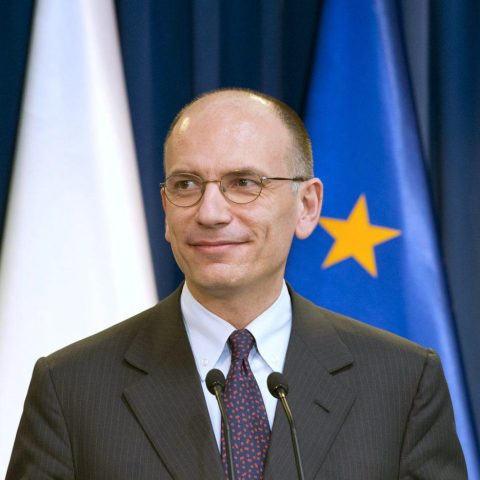
Enrico Letta is President of the Jacques Delors Institute and former Prime Minister of Italy. This article is based on his keynote address, “Single Market and Enlargement: The Future of Europe,” delivered at the Civil Society & Think Tank Forum 2026 in Prishtina on October 7, 2026.