How the vision of a scholar and the support of Prime Minister Edi Rama made it possible to bring one of Europe’s most prestigious institutions to Albania
By Nora Ahmeti
TIRANA, Albania – At 6 p.m. on December 2, 2022, Albert Rakipi, a well-known figure in academic, diplomatic and foreign policy circles, entered the office of Albania’s Prime Minister, Edi Rama. The meeting had been arranged just 24 hours earlier, following a brief message Rakipi had sent to the prime minister: “I have an important idea that I would like to present to you.”
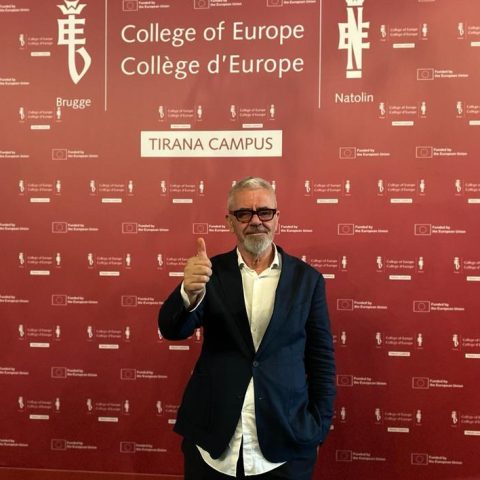
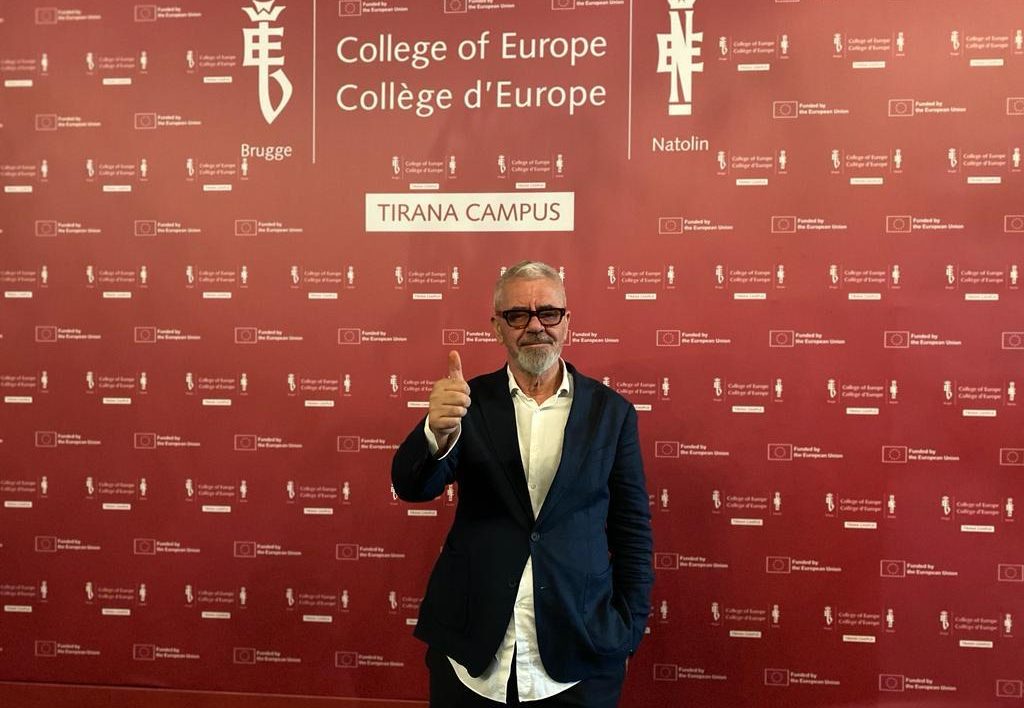
The idea was bold: to bring the College of Europe to Albania and establish its third campus in Tirana.
Four days later, on December 6, the Albanian capital was to host the European Union–Western Balkans Summit. It was the first time a summit of this format had been held outside the territory of EU member states. For one day, Tirana would become the European diplomatic capital of the Balkans, welcoming the heads of state and government of the European Union, as well as the leaders of the six Western Balkan countries.
For Albert Rakipi, Chairman of the Albanian Institute for International Studies (AIIS), this was an opportunity that could not be missed.
“It was the right moment. There could not have been a better opportunity to ask the leaders of EU member states and institutions to establish the third campus of the College of Europe in Tirana,” Rakipi recalls.
The idea had not originated that December.
“For many years, I had been trying to establish a relationship of cooperation between the Albanian Institute for International Studies and the College of Europe. I had made several visits and held meetings. During one of them, with a senior figure in the College’s hierarchy, I had also discussed the idea of opening a third campus in the Balkans. The response had been very diplomatic. So diplomatic, in fact, that I should have understood that my proposal had been regarded as almost an absurdity.
“But when the possibility of holding the European Union Summit in Tirana was first mentioned, I thought this was an opportunity that had to be seized. It was an extraordinary opportunity, perhaps one that would never come again.
“Everything could have turned out differently. The prime minister might have been travelling, he might have been busy, or, for one reason or a thousand, he might not have agreed to see me after receiving my message: ‘I have an important idea that I would like to present to you.’ But he responded immediately to my request.”
The meeting took place on December 2, 2022, just four days before the Tirana Summit.
“We met in his large office, with all those scribbles of his on the walls that he calls paintings…
“I began explaining my idea: establishing the third campus of the College of Europe in Albania, in Tirana.
“I spoke for about 15 minutes. I told him the history of the College, its founding in Bruges in 1949, the opening of its second campus in Natolin, Poland, in 1992, and the powerful political message that this initiative had conveyed about the integration of formerly communist Europe.
“Now, I told him, the time had come for the Western Balkans. Establishing a third campus in Tirana would send an equally powerful message about the European future of the region.
“I concluded my presentation with a direct request: the Albanian government, and you as prime minister, should present this proposal at the European Union Summit that will be held here in Tirana.”
“As I was speaking, I noticed that the prime minister was occupied with his phone. It is a dreadful habit of his, which I believe many others have also experienced: you are speaking, and he is busy with his phone. I thought perhaps he was not listening to me.
“But before I had finished, he said:
“‘Go on, I’m listening. I’m looking for Mogherini’s number so I can speak to her.’
“He was referring to Federica Mogherini, then Rector of the College of Europe, a friend of Albania and Edi Rama.
“‘I’ve finished,’ I told him. ‘That was the idea.’
“‘All right,’ he said. ‘Bring me ten pages on the proposal so I can give them to the leaders at the summit.’
“‘I’ve prepared 50 pages,’ I replied, ‘but I think two pages will be enough. Macron, Scholz and the others only have two hands.’
“‘All right. But what should we offer the College?’ he asked me.
“‘The most beautiful building in the centre of Tirana,’ I replied. ‘A building bearing the inscription in French and English: College of Europe – Tirana Campus.’
“I also proposed the villa of former dictator Enver Hoxha in “the Bllok area” both because of its location and because of the extraordinary symbolism of transforming it into a European institution. Another alternative was the Rectorate building of the University of Tirana, one of the most representative examples of Italian Rationalism in the capital’s architecture, part of Tirana’s valuable architectural heritage from the 1930s and 1940s.
“The meeting lasted a little over 40 minutes.
“The following day, around noon, the prime minister called me.
“‘I spoke with Mogherini,’ he told me. ‘It’s an excellent idea. You have my support. Let’s move forward.’”
Three days later, on December 6, 2022, at 11:56 a.m., I received the following message on my phone from Prime Minister Rama:
“It’s done, they received the proposal with delight 🤣”
From the Proposal to European Support
For Rakipi, the prime minister’s immediate support was decisive.
“It is one of those things that might happen once in a thousand years, or might never happen at all,” he says, recalling the circumstances in which the idea secured the support of the Albanian government.
Rama included the proposal among the materials presented to European leaders during the Tirana Summit. By the end of the summit, the project had secured support in principle from prominent European Union leaders.
Rakipi emphasizes that this would not have been possible without the prime minister’s personal commitment.
“I am very grateful to Prime Minister Edi Rama for the enthusiastic support he gave this project. I am convinced that bringing the College of Europe to Albania would have been impossible without his support.”
Rama’s relationships with the leaders of EU member states and institutions, as well as his often unconventional approach to communication and lobbying, played an important role in advancing the initiative.
An equally important contribution came from Federica Mogherini, Rector of the College of Europe at the time.
“I am grateful to Federica Mogherini, a friend of Albania, who said ‘yes’ without hesitation and devoted herself to this project with exceptional passion,” Rakipi says. “The College might not have come to Albania had Mogherini not been its Rector.”
The support of European Commission President Ursula von der Leyen and other EU leaders gave the project the political and institutional weight it needed.
For the European Union, opening the third campus in Tirana represented a long-term investment in educating younger generations and in the European future of the Western Balkans.
A Ceremony Marking the Beginning of a New Chapter
At the official inauguration of the College of Europe’s office in Tirana’s Pyramid, Federica Mogherini made no attempt to conceal her enthusiasm.
“Today, in beautiful Tirana, we are inaugurating the first office of the College of Europe, which will pave the way for the establishment of our campus, scheduled to begin its activities in the 2024–2025 academic year,” she declared.
“It is truly an honour for me. I am very proud. Look at my smile: it is a genuine smile. I want to thank, first of all, everyone who made this possible.”
The Tirana campus was to welcome students from Albania, the Western Balkans and European Union countries. During the initial phase, there was discussion of a group of 31 students.
European Commission President Ursula von der Leyen described the opening of the College as a development of particular importance for Albania and the region.
“This is fantastic,” she said. “First, because an institution of excellence in higher education such as the College of Europe can contribute to the development and prosperity of Albania and the region. But also because the College will strengthen efforts to bring Albania and the region closer to the European Union.”
At the October 16 ceremony, von der Leyen described the campus as a mutual gift between Europe and Albania.
“Here we will have students from Albania, from across the Western Balkans and from the European Union. They will lay the foundations as the leaders of the future,” she declared.
The president recalled that the College of Europe had established its first campus in Belgium and its second in Poland, while Tirana was now becoming home to its third campus.
“The College came to Poland before it became a member state of the European Union, and I am convinced that the same will happen with Albania.”
She described the campus as “a great gift from Europe to Albania,” but also as “a great gift that Albania gives to Europe.”
Prime Minister Rama, speaking at the ceremony, expressed surprise at the speed with which the project had been realised.
“Who would have thought that this would happen so quickly? Yesterday, the President of the Commission announced the opening of applications, today the doors of the representative office are opening, and next year students will begin their studies at the College of Europe in Tirana. Something is happening, and it is truly wonderful.”
Rama linked the project’s importance to the need to build democratic institutions and strengthen ties with the European Union.
“Knowledge is the most extraordinary gift that the European Union can give us,” the prime minister emphasized.
A European Institution in the Heart of the Balkans
The College of Europe is one of the oldest and most prestigious institutions of postgraduate education in European studies. It was founded in 1949, following the 1948 Congress of The Hague, by prominent figures who believed in the necessity of Europe’s political and institutional unification.
Its first campus was established in Bruges, Belgium. In 1992, following the end of the Cold War, the College opened its second campus in Natolin, near Warsaw.
The establishment of the campus in Poland carried a significance that extended beyond education. It expressed Western Europe’s determination to include the countries of the former communist bloc in the project of European integration.
Three decades later, a similar message would be conveyed from Tirana.
For Rakipi, the choice of the Albanian capital was no coincidence.
“The December 2022 Summit created an extraordinary opportunity. The enlargement process in the Balkans had gone through long periods of slowdown and stagnation. Europe needed to send a renewed signal of confidence and commitment to the region. The College of Europe in Tirana was precisely such a project.”
He believes Tirana was the right location for the third campus, not only because of Albania’s position in the Balkans but also because of the historical and political symbolism of the choice.
“President Ursula von der Leyen, President Charles Michel and other leaders in Brussels may today view the College of Europe in Tirana as an investment and a strategic vision for the Balkans,” Rakipi says.
“But the idea and the project originated in Tirana, at the Albanian Institute for International Studies.”
For him, the arrival of the College of Europe also has a personal dimension.
“All of this is like a dream. Within a very short period, an idea that had seemed almost impossible became a reality. I am very proud that I was able to help my country with an idea and a project that is beautiful, beneficial and so important.”
A Permanent Link Between Albania and the West
In Rakipi’s assessment, the arrival of the College of Europe in Tirana represents one of the most significant developments in the history of Albanian education and in the country’s relations with Europe.
“It is an event of historic importance because it represents another step towards Albania’s permanent connection with the West,” he says.
The Tirana campus places Albania on a new European academic and institutional map. It creates opportunities to educate new generations of professionals, diplomats, scholars and future leaders who will contribute to the continent’s political and institutional development.
Rakipi compares the significance of this project with some of the best-known Western educational initiatives in Albania’s modern history.
“Bringing the College of Europe to Tirana means bringing a first-class Western educational institution to the country. In this sense, it is perhaps the most important development of its kind in Albanian education in a century, following institutions such as the French Lycée of Korçë and Harry Fultz’s American School in Tirana.”
Nevertheless, the significance of the campus is not limited to Albania.
“The College of Europe in Tirana is, above all, a signal of hope and a symbol of the European Union’s serious commitment to the Western Balkans,” Rakipi says.
He believes the institution will encourage academic, social and cultural cooperation among the countries of the region, as well as their relations with European Union member states.
In a region where the legacy of conflicts and political divisions continues to affect relations between states, a shared European institution can also play an important role in bringing younger generations closer together and strengthening regional reconciliation.
The Institute Where the Project Originated
The Albanian Institute for International Studies (AIIS), where the proposal to bring the College of Europe to Albania was conceived and prepared, is an independent research organisation focusing on international relations, foreign policy, security and European integration.
Founded by a group of academics and foreign policy experts, AIIS has developed over three decades into one of Albania’s leading centres for research and public policy analysis.
The Institute has contributed to debates on security, democracy, Euro-Atlantic integration, international relations and regional cooperation. It has established relationships with academic institutions, international organisations and research centres in Europe, the United States and beyond.
Through its studies, publications, conferences and foreign policy forums, AIIS has brought international perspectives and expertise into Albanian public debate, involving scholars, diplomats and policymakers from various countries.
Since 2023, AIIS has been part of the network of academic institutions of the European Security and Defence College (ESDC).
The Institute has also been recognised in international rankings of research centres, including the University of Pennsylvania’s Global Go To Think Tank Index, where it has been ranked among the most prominent institutions of its kind in Albania and the region.
Johns Hopkins University Professor Daniel P. Serwer has praised the role of AIIS in Albania’s democratic and international transformation.
“Albania has made extraordinary progress over the past 30 years and is moving wisely towards its European home. AIIS is both a cause and a consequence of this development,” he has said.
“Its sharp analytical focus on the world beyond Tirana has helped a country once among the most isolated in the world become an active contributor to the international order.”
An Idea That Left Its Mark
The story of how the College of Europe came to Albania demonstrates how an academic initiative can develop into a project of political and institutional significance when it receives the right support.
Albert Rakipi’s initiative, the immediate support of Prime Minister Edi Rama, Federica Mogherini’s commitment and the backing of European Union leaders created the conditions for the realisation of a project that, only a few years earlier, had seemed difficult to imagine.
The College of Europe in Tirana is now an institutional reality. Beyond the building where studies take place and the number of students enrolled in its programmes, it carries a broader significance: the presence of an important European institution in a country aspiring to become part of the European Union.
For Albert Rakipi, it is also proof that a bold idea, presented at the right moment and supported with determination, can change the course of events.