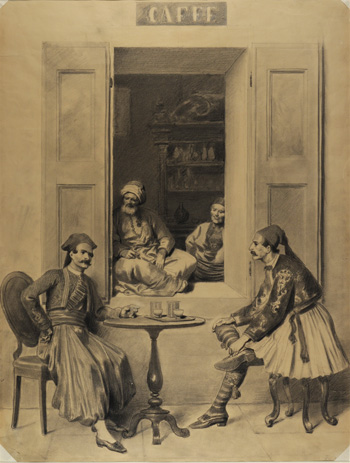
An picture engraving by Francesco Beda from 1888 at the Museum of Oriental Art of Trieste, depicts for personages, two out which are thought to be Albanian. The engraving is called ‘The Oriental cafe of Trieste’, and portrays four men in the cafe, two drinking coffee, and the other two, thought to be the owner and the waiter, are listening to the conversation between the two clients.
Why these two men drinking coffee are thought to be Albanian, is due to their outfit. One of them is wearing the traditional fustanella, a belt, vest and tasseled toupee. The other one is wearing a vest and benevrek. Fustanella is a traditional Albanian kilt worn in all regions of the country. This can be proved also by the numerous photos from the Marubi collection, which depicts Albanians from various in their traditional outfits. The kilt is a dominating piece.
English historian George Finlay writes of the cultural appropriation of the Albanian kilt to the Ottoman Turks, Greeks and other Balkan countries, this concluded after his extensive travels in the Ottoman Empire, Albania, Greece, Macedonia, etc.. He wrote that the Albanian traditions were highly valued and imitated from the other nations.
‘’[…] even the Turks who were influencers of the military tastes and customs, became imitators of Albanians. […] A small sign, but noticeable, to the high position that Albanians gained were the general acceptance of their outfits. A usual thing then, in Greece and Macedonia was to see the proudest small Osmanli children wearing the fustanella or white kilt of Tosks (Note: southern Albanians are traditionally known as Tosks and northern Albanians as Gegs),’’ wrote Finlay in his diaries.
The other conversationalist is wearing a vest and a benevrek. The benevrek is an outfit worn by the catholic citizens of Albanian from mid-19th century until 1920s. The benevreks were made from imported cotton fabric and would be sewned at tailors known as terzi. The two other persons identified potentially as the owner and the waiter are wearing Ottoman outfits, long loosened clothing and the turbans.
The engraving conveys a mutual communication between cultures, and Albanians were at various both sides of the Adriatic Sea had a strong presence both in the Adriatic and in Levant (Asia). In 1912, about 50 percent of the foreign trade volume of the Ottoman Empire with Austro-Hungary and Trieste was conducted from Albanian regions, as the only harbor in the Adriatic. Such engravings, various artefacts and other witnessing of Albanian presence around the world could be traced in the benefit of completing the missing mosaic of our European and Mediterranean culture.