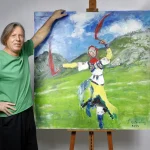
TIRANA, Sept. 30 – The “Revival of Lazarus’’ icon, which was restored six months ago, will be gifted to UNESCO in accordance with a decision made by the Council of Ministers, which also holds the signature of Prime Minister Edi Rama.
The icon was created in the 19th century and belongs to the Evangelism church. Appraised by specialists as a work of high artistic value, the icon has been degraded over the years due to indifference. But since the restoration process started in the beginning of March, the rich colors of the icon are again noticeable.
The icon is linked to with the tradition of Easter, whereas the figure of Lazarus symbolizes the fine line between mortal life and afterlife. Lazarus is considered the protector of the forests in popular tales.
There are a lot of songs and dances to the figure of Lazarus, which represent the wishes for good health and prosperity. The masters of the house are blessed, the youth, the children and brides. The young women go home dancing and they are given uncolored eggs and money. This ritual ends with the girls’ returning from the road they came from.
The decision from the Council of Ministers published in the official gazette lists also the rest of the procedure for the donation finalization of this cultural heritage:
The “Revival of Lazarus’’ icon is a representative of the iconic art in Albania, which took a new development between centuries 18 and 19.
The 18th century in Albania is characterized by a crucial socio-economic development, the rise of trade between towns, the construction of many cult institutions and their embellishment with art pieces from various genres.
The icons and murals from this period count to thousands. They have adorned multiple monuments around the country and the autographs belong to Albanian artists. Some distinguished painters are David Selenica, Konstandin Shpataraku, Konstandin and Athanas Zografi, Gjergj and Joan Cetiri, etc.
The icons of 18th century Albania belong to the school of Korca, which apart from the local tradition it also inhabits characteristics from western methods. In the Zografi brothers, for instance, one can notice traces of the baroque style.
Comparing from the icons of the previous centuries, the ones belonging to the 18th century adopt a more complicated technique, which also includes some byzantine linings of graphics and symmetry. The drawings of the figures focus on realism, and the portraits are modeled using plastic. The scenery also appears modeled and the ethnographic elements are multiplied.