TIRANA, Feb. 18- The League of Albanians in Romania (ALAR in Romanian) decided to republish the scientific and cultural magazine Albanica, originally established by Dr. Anton B.I. Balota in 1936. The ALAR is the Albanian ethnics minority representative party in Romania. Albanica magazine was published in Bucharest and proposed to be a pioneer in Albanian philology.
The magazine was planned to publish other issues where besides discussing theoretical Albanian philology problems, it would also offer more information regarding Albania and its people. This information would be concerning their past and present, folk or contemporary literature which would be translated in Romanian, followed with aesthetic textual analysis. It would also include research surrounding the dialects of Albanian language, associated with vocabularies.
The original magazine from Balota was dedicated to historian Nicolae Iorga, but unfortunately fell through after its first volume. The project undertaken by ALAR in reviving the magazine considers a more comprehensive resumption. The director is scholar Dr. Radu Cosmin Savulescu, and General Secretary of Editorial Office is Dr. Liviu Lungu. The editor-in-chief assigned to this reissuing will Dr. Luan Topciu.

Dr. Topciu has graduated for Literature in Albania, and then continued his graduate and doctoral studies at the University of Bucharest for Comparative Literature. He has served as an external lecturer there from 1997-2004, and has been a professor at the Philology Faculty of Tirana University from 2005-2016. He has been editor-in-chief in a number of publications in Bucharest regarding Albanians, and has translated numerous Albanian authors in Romanian and vice-versa. He is currently co-authoring a Romanian-Albanian Academic Vocabulary.
“The League of Albanians in Romania launches the first issue of the Albanian Cultural and Scientific Magazine in mid-February, a quarterly publication aiming to publish significant texts belonging to Romanian and Albanian authors about the Albanian community in Romania and its personalities about Albania, about Albanian language and culture, but also about relations between the two languages ”‹”‹and cultures. Thus, the journal will cover topics such as history, literature, linguistics, anthropology, spirituality, sociology, philosophy, arts, etc.,” is written at the official website of ALAR regarding Albanica.
From the historically rich landscape of the Albanian press in Romania, scientific and university journals have been missing. “Albanica” aims to grab around itself all the Albanian scientific forces, as well as the representative creative forces of literature and art. Its content will be addressed to the Romanian elites, academics and scholars, and whomever else that might be interested to connoisseur the Albanian culture and spirituality in more depth. It seeks to become a theoretical instrument to those interested for the southeast European Albania, with the ancient history of its people, for the Albanian language, literature and art. To explore its multidimensional relations with the Romanian and Balkan culture. To see the ancient Albania and the European one, with the identity and visions to the common future.
The magazine will be opened with a passage of Nicolae Iorga from his 1915 discourse “Albania and Romania” held at the Southeastern Europe Studies Institute. Iorga holds a sympathizing outlook to the history of Albanians in his lecture. He also added that “[…] the following discourses will point out the kinships among us (Romanians) and the Albanians, those authentic and exclusive descendants of the Illyrian element.”
Dr. Lavinia Dumitrascu is publishing the article “The Albanian-Romanian Ibrahim Themo.” Dumitrascu stresses on Dr. Themo’s contributions in the establishment and activities of the Albanian patriotic clubs, in the opening of Albanian schools, and relevant to that, in his support for the latin alphabet of the Albanian language. When Themo served as senator on Romania’s Senate, he gave his contribution in the emancipation of the Drobuja area, the modernization of the Turkish politics at the times, etc..
Among the articles, one is written by academic Grigore Brancusi, a renowned linguist and albanologue. His article “The substratum of Romanian language” argues that the language is formed by a Thracian-Dacian element, supported by multiple example from Albanian, as being one of the oldest languages in Europe. Relevant to that, Dr. Daniela Carmen Stoica brings her research “The lexical field of death in the Romanian and Albanian languages. Lexical-semantic conjunctions.” This article investigates the linguistic material used in sociolinguistic studies on expressions referred to death. The comparison in this article is done both on an anthropological and linguistic plane.
Still on the linguistic sphere, an article by Dr. Ina Arapi titled “Albanian-Romanian expressions and phraseologies” makes a summary of the essential studies done on this field, along with results achieved. She also adds new examples and observations, enriching thus the common stock of phraseologies.
In a cultural spectrum of the journal, a study from Dr. Renata Topciu-Melonashi titled “Beliefs, habits, superstitions and practices in Albanian-Romanian phraseology” will highlight a number of customs, beliefs and practices which are similar to Albanians and Romanians through a comparative phraseology.
An anthropological study with psychoanalytic tendencies is also the article by English scholar Margaret Hasluck, “Oedipus, king in Albania.” This is an interesting research of the Albanian folklore using Sigmund Freud’s Oedipal complex, analyzing numerous folklore figures such Fate, Oras, Fairies, etc..
Other articles discuss religion in Albania. An article from Kristo Frasheri discusses the spreading of catholicism in Albanian territories, and analogous to that, an essay from Faik Konica regarding religions of Albanians will be also published. An article from Dr. Erion Piciri, “Many busts, little models,” analyzes the historical and social phenomenon of the reexamination of the value system, as real personalities who should have been role models for society, were left in shadows.
A large space is dedicated to the most important figures of the Albanian modern literature. A number of Romanian translated poetry from Migjeni are being published. “The friend” from Ernest Koliqi, a literary treasure, will be also introduced to the Romanian public. Contemporary writer Visar Zhiti will be introduced with a chapter from his novel “Endless funeral,” and renowned Romanian writer of Albanian descent, Victor Eftimiu, has his “An aristocratic wedding” short story.
Dr. Luan Topciu, who is also editor-in-chief for the journal, has reserved a chapter to the history of Albanian literature and studies. He will be publishing his article “Recreation of the lost spiritual map,” which discusses the literature of Italian Arbereshe, which is characterised by European literary motifs, beside preserving the Albanian cultural matrice with archaic Balkan figures.
An inescapable topic is always internationally renowned Albanian writer, Ismail Kadare. A research article from Dr. Gustavo Loria titled “Finally the file on H is opened,” concerning Kadare’s captivating, imaginative and dramatic book “The file on H,” which comes with a number of scientific facts. Dr. Loria has worked as translator with a work-body under Harvard University, and has published a number of texts attained by Parry Lord in Albanian. “Gjakmarrja, the bloody breath of fate” from Romanian literary critic Marius Chelaru, is a study on Kadare’s “Broken April,” “The ghost rider,” and “Spring flowers, spring frost.” Chelaru offers an analysis on the kanun (traditional laws) that Kadare uses in his works.
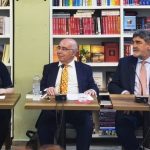
The first number of the 250 page cultural and scientific journal was inaugurated at the Romanian Literature Museum on Feb. 12. A second inauguration for the journal was made on the seaside town Constanta on Feb. 14 with the participation of academics and students from the “Ovidius” University, historians, members of the Albanian community, etc.. A third inauguration will take place at the Craiova University, so ALAR can better immerse itself and Albanica to the wider Romanian public.