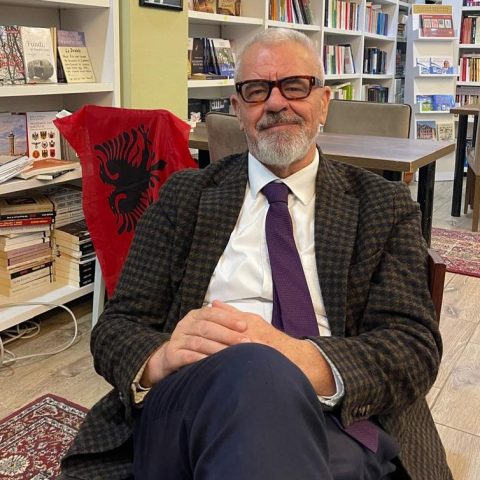
TIRANA, Dec. 7 – Bashkim Shehu was honored with the ‘Balkanika 2015’ award on Sunday, the Balkans’ equivalent of the Nobel Prize in literature. At the ceremony, which was held in Skopje, the Albanian author competed against a number of important names in the field of Balkan literature, while it was the second time he was selected to participate in this regional competition.
The novel that awarded Shehu the Balkanika was ‘Loja, shembja e qiellit’ (Game, the collapse of the sky), brought by the Toena Publishing House. This novel also awarded Shehu the “At Zef Pllumi” Prize in 2013, an equally important national award. He was prized “Author of the Year” by the commission of Fier’s Book Fair that same year.
In 2007, Shehu was represented in the ceremony with the novel ‘Angelus Novus’, with which he competed against two other authors. It was ‘Loja, shembja e qiellit’, however, that gave Shehu regional recognition, while a number of articles and positive critiques were written by the media praising him and his work.
For the ‘Balkanika 2015’ Award, Shehu competed against six other prominent authors from six different Balkan countries: Vladimir Yankovski’s “Invisible Love” (FYROM), Christo Karastoyanov’s “The Same Night” (Bulgaria), Ana Ristovic’s “Directions for Use” (Serbia), Seray Šžahiner’s “the Hairstyle of the Bride” (Turkey), Dimosthenis Papamarkos’ “Blood” (Greece) and Simona Sora’s “Hotel Universal” (Romania).
“Placed under a long time period, from the 40’s to the beginning of the 00’s, the novel leaves indelible traces and forces the reader to face hard and uncomfortable questions concerning the universality of guilt, faith and loyalty, the shaping of authoritarian figures and whether it is possible to find balance and happiness after certain traumas,” Andre Wachtel, American professor and director of the commission, said.
Shehu’s novel centers on the psychological drama of a young man who has problematic relations with his father’s authority, the state’s authority, and God’s authority. His youth abruptly ends, desires and loves get violently interrupted, as he becomes persecuted under communism and ends up in jail. In the post-dictatorship era, he becomes disoriented, surrounded by “a crazy wave of phantoms that have been chasing him his entire life” , and seeks for a way-out through religion, which he ultimately cannot adhere to. Meanwhile, he befriends a Franciscan priest, a co-sufferer of his, in whom he finds spiritual support and peace. And at some point, after he leaves prison, he decides to avenge his friend – a non-violent revenge, but horrible and ruthless nonetheless. Whether he manages to complete his revenge becomes the quest of the book. Scenes from two different time periods interlink in the novel, including real scenes depicting the entrance of weapons in Shkodra’s Franciscan Convent from the State’s Security during Communism.
Except for Shehu, the other two Albanians writers that have received the Balkanika Award were Fatos Kongoli, in 2002, and Ismail Kadare, in 2009. The Balkanika Foundation, which distributes the awards, is established in Sofia, Bulgaria and cooperates with a number of publishing houses from around the Balkans.