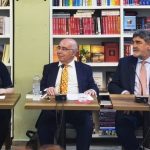
On the occasion of the 100th birth anniversary of Yaniss Ritsos the Greek embassy and the Greek Foundation of culture organizes a poetic evening themed “It was worthwhile to exist, so that we meet”. A documentary on the life and work of Ritsos will be shown on the evening followed by speeches from Besnik Mustafaj, Perikli Jorgoni etc
Early life
Born to a well-to-do landowning family in the Monemvasia, Ritsos suffered great losses as a child. The early deaths of his mother and his eldest brother from tuberculosis, the commitment of his father who suffered with mental disease and the economic ruin of losing his family marked Ritsos and affected his poetry. Ritsos, himself, was confined in a sanitarium for tuberculosis from 1927 – 1931.
In 1931, Ritsos joined the Communist Party of Greece (KKE). He maintained a working-class circle of friends and published Tractor in 1934, inspired of the futurism of Vladimir Mayakovsky. In 1935, he published Pyramids; these two works sought to achieve a fragile balance between faith in the future, founded on the Communist ideal and personal despair. The landmark poem Epitaphios, published in 1936, broke with the shape of Greek traditional popular poetry and expressed in clear and simple language a message of the unity of all people.
In August 1936, the right-wing dictatorship of Ioannis Metaxas came to power and Epitaphios was burned publicly at the foot of the Acropolis in Athens. Ritsos responded by taking his work in a different direction: exploring the conquests of surrealism through access to the domain of dreams, surprising associations, explosion of images and symbols, lyricism which shows the anguish of the poet, soft and bitter souvenirs. During this period Ritsos published The Song of my Sister (1937), Symphony of the Spring (1938). Today, Ritsos is one of the four great Greek poets of the twentieth century, together with Kostis Palamas, Giorgos Seferis, and Odysseus Elytis. The French poet Louis Aragon once said that Ritsos was “the greatest poet of our age.” He was unsuccessfully proposed nine times for the Nobel Prize for Literature. When he won the Lenin Peace Prize (also known as the Stalin Peace Prize prior to 1956) he declared “this prize it’s more important for me than the Nobel”. His poetry was banned at times in Greece for its left wing content. Notable works by Ritsos include Tractor (1934), Pyramids (1935), Epitaph (1936), and Vigil (1941-1953). Ritsos mainly wrote poems with political content, “serving communism with his art” as modern philologists describe.