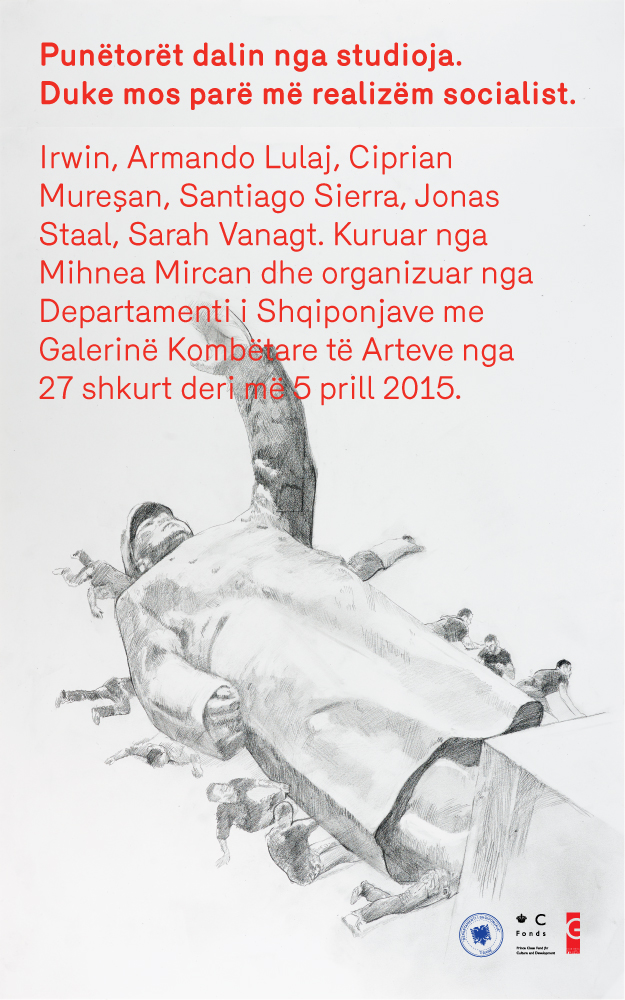
TIRANA, Feb. 26 – Six internationally renowned contemporary artists are exploring the socialist realism period in Albania also known as the “Creation of the models of the New Man,” a genre serving the communist regime propaganda cultivated between 1960 and 1986 in a collective exhibition at the National Gallery of Arts.
“Workers leaving the studio. Looking away from socialist realism,” curated by Romania’s Mihnea Mircan features works by Irwin (Slovenia), Armando Lulaj (Albania), Ciprian Mureşan (Romania), Santiago Sierra (Spain), Jonas Staal (Netherlands), and Sarah Vanagt (Belgium), as well as an exclusive selection of works from the collection of the National Gallery of Arts.
“This exhibition is an attempt to articulate specific fragments of the collection at the National Gallery of Arts in Tirana and contemporary art projects whose concerns revolve around the notion of realism,” says Belgium-based curator Mircan.
“It works through two hypotheses about the realism of socialist times, the two ways in which that discourse did not end. The heroic drive in those images, banishing metaphor but having it return as Freudian slip, undermines and corrodes their realist aspirations, and deflates the mimesis of a world ‘to come.”
On the other hand, the relations between artistic freedom and political subservience that underpin socialist realist art production radicalize an equation that contemporary engaged practices must also respond to, even if within a different regime of political interlocution.
The exhibition organized by the National Arts Gallery and the Department of Eagles will be open to the public from February 27 to April 5.
The Department of Eagles was established in Tirana in 2011 as a weekly reading group bringing together students and scholars from diverse disciplines in an attempt to reinvigorate the discourse of the “liberal arts.” Over the last years, this interdisciplinary group has developed into an independent project bureau for artists and thinkers in and beyond Albania.
Socialist realism
Socialist realism artworks have attracted huge attention recently after some of them were selected to showcase in the premises of the government residences.
“The major part of the National Gallery’s collection belongs to socialist realism. I have noticed that all collectors and curators show special interest in this period, because not everybody has had the luxury to experiment or touch it,” says Artan Shabani, the director of the National Gallery of Arts in Tirana.
“The majority of visitors are very curious to see what happened those years in the language of art, attempts to challenge time and getting out of the frames, formalism etc,” Shabani has said.
The Socialist realism genre started in the early 1960s with the return of Albanian artists graduated from East European art schools.
The art of this period is entirely propaganda, serving the interest of the political regime in power. “Based on clichés imported from its originating place, the former Soviet Union, this art focused on the workers and their actions, transforming them into ‘myths’ of the period. In fact, socialist realism does not try to show openly and truthfully the daily aspects of the reality of the working class, but strives to erect and establish the socialist working activity as some sort of a cult while placing the common worker as the main character of a ‘new epoch’,” says the National Gallery about the permanent socialist realism pavilion.
Noted artists who have developed significant works in this genre included Kristaq Rama, Muntaz Dhrami, Zef Shoshi, Pandi Mele, Myrteza Fushekati, Petro Kokushta, Çlirim Ceka and many others.
The Albanian National Arts Gallery was originally founded in 1954 and moved to its current location on Tirana’s central boulevard in 1974. The national collection of visual arts ranges from a collection of religious icons from the 13th to the 19th century, works from the National Renaissance and Independence period (1883-1944), the biggest painting and sculpture collection in the country from the socialist realism period (1944-1990), as well as a foreign artists’ pavilion and rotating collections of contemporary national and international art.
Some of the most important annual exhibitions include the “Onufri,” international visual arts contest and the Marubi international artistic photography competition.
The gallery is surrounded by a lovely park, and as a special bonus at the rear of the building there are a few still-defiant Communist-era partisan statues clenching their fists at the sky, as well as imposing statues of Lenin and Stalin.