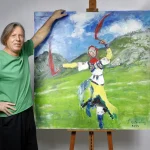
Treading on the streets of Paris, the following is what a by-passer would have seen if he were walking down rue Saint Jacques last week:
The Fall of the Idols
Artur Muharremi
Personal Exhibition
18 – 31 May 2009
ARCIMA (Art Gallery), 161, Rue Saint Jacques, 75005, Paris.
Camera in hand, Artan P쳮aska visited the exhibition and met the artist. He delivers the following report:
Only a few steps away from the Pantheon, close to the Luxemburg Gardens and the Sorbonne, at the heart of Paris, on Rue Saint Jacques, seats the ARCIMA Art Gallery where from the 18th to the 31rst of May, Artur Muharremi, an Albanian painter, was hosted with a personal exhibition. Titled The Fall of the Idols, the exhibition united some 18 or 19 works belonging to the last cycle of the author, all in the oil technique, with different sizes, mostly mid-size to big.
Artur Muharremi is one of the most hailed painters in Albanian modern art. Describing the graphical evolution of Muharremi in the last two decades, art curators remind us that the canvasses of Artur Muharremi have successively shown figurative and realist nudes, abstract art, beautiful still life scenes and lately are concerned, metaphorically, by the fate of man.
“The characters in this exhibition are without visages, without identity. In this absence faces, in this absence of identity everyone can see something for himself.” – says Artur Muharremi to Tirana Times. “The background is leaning. Everything has begun to lean compared to the common verticality of the things. Things are siding. All is cracking and getting awry. Skewed is the background.”
The exhibition is only part of the cycle on which the author has been working.
“In Albanian, I called this pictorial cycle “Per쯤ia e r쯫” (literally fallen God). Man is a fallen God. Fallen God is the humane being.” – says the Muharremi. “The human is reduced to no path. He is facing the crossroads’ dilemma. He is standing there in the crossroad. There are five hundred streets to take. But you don’t know which one to take.”
A quick perusal of the canvasses hung at ARCIMA revealed them to be recent works, mostly from 2008 and 2009. Actually, Muharremi is reflecting and working on a new cycle that he called, “Šthe transcendental mummification of human existence”. “I am searching within Man. We have always heard of black spots or black pits on the sun. But I think these black spots or black pits can be found in the interior of man.” – says Muharremi, who adds that the characters “who are void will be wholly become figurative through disbanded or loose fascia that will envelop an empty body or an empty face. Though this emptiness is only suggested, it is not overcome by anything. It is losing emptiness to all the world. You can push gold into the void, banded by the fascia, and it will not appear. The void aspirates and most disappear. The worst thing for man is man himself.”
We stop by a painting which is unlike the others. The central figure is a naked woman. The background is abstract with contrasting colors, with vivid red and a profound hueful black-tone. The image as focus-driven and tone-confined is concentrated and makes the eye captive. The woman holds a fiddle. Two rays of light come from the rear ground and cross with linear regularity and light somewhere before her pubis. One of the legs is painted in red. With this reddened leg, she enters into the background and becomes one with it. She seems to spring from the vivid red background.
“Tradition has it that the red sock has been worn by the courtesans. But a red sock is in every one of us. The red sock is not only for women but also for men. Courtisanship is now on the air.” – says the author.
We ask him whether Paris has inspired any of his works. “I do not receive that inspiration directly” – answers Muharremi. “It comes indirectly. If it came as a direct impression it would be superficial. But it surely works on the subconscious level, and brings reminiscences to the creative process. In the same way, reminiscences of Berat in Albania and of the Albanian Byzantine-style icon painting bring recognizable Beratine or Albanian forms, and Albanian Byzantine style
Artur Muharremi was born on the 2nd of June 1958 at Pogradec, on the south-east of Albania. He completed the Fine Arts Academy of Tirana in 1983. He was cartoon-maker at the Albanian national film producer, Kinostudio, and over the eighties won esteem and awards for his cine-pictorial work.
In 1991 he opened his first personal exhibition in Tirana, at the National Gallery of Arts. It was at the time-line of the liberation of whole spans of Albanian life, after a long freeze under communist rule, (though a slow liberalization process that had been under way at the second half of the eighties). In the nineties, Artur Muharremi tried new forms of expression and opened many exhibitions in Albania and in Greece, where he lived for a while.
A considerable number of paintings by Artur Muharremi have been bought and are conserved at the Mezuraj Museum of Art.
The exhibition titled The Fall of the Idols is his second exhibition in France (The first was a collective exhibition at Place to the Artists, “Place aux Artistes”).