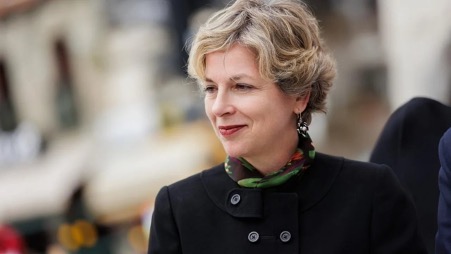
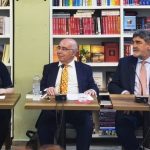
Well-known Albanian journalist, writer, and dissident Fatos Lubonja received the prestigious Prince Claus Award from the ambassador of the Kingdom of the Netherlands Dewi van de Weerd on March 14, 2016 in Tirana.
According to the Prince Claus Awards Committee Report, “Fatos Lubonja is awarded for his honest and lucid literary accounts of crucial episodes in Albania’s recent history; for maintaining his intellectual integrity and independence in extreme circumstances; for continuously fighting for democracy, human rights, free speech and the right to tell his country’s story in a context where that freedom remains fragile; for broadening the scope of public debate and providing platforms for other critical voices; and for fearlessly speaking truth to power.”
Fatos Lubonja is one of the eleven 2015’s Laureates and the first Albanian citizen to receive the Prince Claus Prize. The Award ceremony was held at Tulla Culture Center where Lubonja’s close friends and family as well as a representative of the Prince Claus Fund attended.
“Fatos is awarded for continuously fighting for democracy, human rights and free speech. He broadens the scope of the public debate and, this way, he makes room for the critical thinking of others, too. He has always maintained his honesty and independence. Therefore, I am honoured to be able to hand him the award today,” van de Weerd said during her presentation.
“Literature, among other things, helps us to understand and express ourselves, to understand and communicate with others, to develop our sympathies and our capacity for empathy. These are very important for becoming more responsible towards ourselves and to others,” according to Lubonja.
Honoring artists and cultural role models for their pioneering work in culture and development, The Prince Claus Award is held each year inviting people to make nominations and make a shortlist of candidates that are later presented to the Prince Claus Fund in June. For the 2015 award the Bureau received 103 nominations from 250 people that were invited to make nominations.
Read the Ambassador’s speech below:
By Dewi van de Weerd
Each year, The Prince Claus Awards are presented to artists and intellectuals in recognition of both the excellent quality of their work and their significant impact on the development of their society. In 2015, the Prince Claus Awards Committee has decided to present one of their awards to Fatos Lubonja, a journalist, author, television commentator and leading critical voice in this country. Fatos is awarded for continuously fighting for democracy, human rights and free speech. He broadens the scope of the public debate and, this way, he makes room for the critical thinking of others, too. He has always maintained his honesty and independence. Therefore, I am honoured to be able to hand him the award today.
As an embassy, we are active in the field of Human Rights and especially freedom of speech. We are determined to support investigative and critical media. We believe that freedom of speech is not only important for maintaining a critical outlook towards those who are in power, but that it can also give hope, especially when trust towards those who are in power is low. Fatos Lubonja conveys the value of freedom of speech in a very brave and persistent manner, which is why we strongly believe that he deserves this award. He speaks out against oppressions and wrongdoings and he exposes frauds and abuses of those in power, regardless of their political affiliations. In 1997, he played a key role in political events as chairman of the Forum for Democracy. In a time during which this was much needed, he fought for democracy.
The Prince Claus Fund has made it its mission to connect people and cultures and to see things in perspective, preferably from the perspective of the other. It bears forth an idea: that culture, especially cultural interaction, helps people to see each other. Fatos Lubonja provides a great example of how culture can be used to put things in perspective and to develop our capacities to see the other. To quote him: “Literature, among other things, helps us to understand and express ourselves, to understand and communicate with others, to develop our sympathies and our capacity for empathy. These are very important for becoming more responsible towards ourselves and to others.”
Fatos was arrested at the age of 23, when the police discovered his critical writings of dictator Enver Hoxha. In many publications, Fatos has described his 17 years in prison. According to the laudation by John Hodgson, Fatos focusses in these works “on the human ability to adapt, resist and survive, even in the most adverse circumstances. He reflects on the relationship between courage and fear, and the necessity of both.” It is perhaps because of this experience in prison that he learned that being lonely or separated from society, does not mean that you cannot have a positive impact on that society. Fatos himself describes this in the following way: “Dissidence is to feel yourself as part of your society and at the same time to think and live in confrontation with the dominant culture of that society, that is the culture of power.” I admire how Fatos has managed not adapt to the rules and power structures of the society that he is part of. By maintaining complete independence from all political parties and by being consistently objective in his analysis, Fatos has made a real difference. Therefore, it is a privilege for me to invite Fatos to the floor.