Tirana, Dec 16 — An art exhibition of artist Franc Ashiku opens on Thursday 18 December 2008, 18.00 at Zeta Gallery in Tirana. Franc Ashiku (1925-1998) is part of a generation of remarkable Albanian intellectuals who, during their lifetime, contributed for their country – on top of the emergencies manufactured by that reality – with idealism and dedication so that Albania could catch-up with the other countries. Unfortunately, Franc got the share of living in hard times.
That of the communist dictatorship, which in art, more than anywhere else, it harshly hampered the freedom to create and often it persecuted the artists. Through Franc Ashiku`s exhibition and through his works, we will try to spotlight a very important moment in the development of graphics in our country. Posters at that time were totally politically perceived and, in most cases, based upon the conceptual and formal structure of the Soviet model. Franc Ashiku, managed very carefully to surface anti-conformist, creative situations, thus offering a rhythm and form of composition, outside the schemes of the time, through a synthetic analysis of the concept or through the interpretation of the poster’s subject-matter. His oeuvre had a direct impact on other events of that time, such as textile industry fairs or festive exhibitions of anniversaries, where the country’s economic strength and achievements were on display; where improvised elements were exhibited demonstrating culture gauges in the field of design and graphic work.
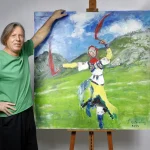
On these occasions, he interfered creating exhibition environments, significantly affecting the public eye, by using his fine taste and an abstraction scale of symbolic elements; by means of graphic works that were very contemporary for the time, as well as of a modern interior design. The series of Franc Ashiku`s posters that we have thought to exhibit today clearly expose these qualities. We also think that they reveal curiosity to us today, as they are stories which best tell us about the time when these experiences started, about the topics discussed, the kind of advertising that was used and other elements from the political, economic and social propaganda of the time. The paintings are another significant moment of this exhibition and for the artist’s oeuvre.
The history of our art is young and it has been framed by factors which have accompanied it until nowadays, in line with the historical developments which were in fact cruel and tense. In this backdrop of relations, institutions and systems were structured (until lately so), which in most parts, failed to lead us properly, and as such they caused delays and left room to vulgarity, misunderstandings and persecution. In this context, the paintings of Franc Ashiku are a product of the tradition of works of earlier painters such as Idromeno Marubi, Kolombi and Rrota and of the entire milieu that Shkodra offered. And what I mean here is every line, form and color the city’s architecture, traditional costumes, music, celebrations, and way of life, imposed. He was influenced also by young artists of that time like Danish Jukni, Thoma Dhamo, Vilson Kilica, Ksenofon Dilo, etc, who created a somehow western atmosphere in their discussions among each other. I think that all this creativity it has to do with his dimensions as an artist and intellectual; it has to do with his efforts to communicate through a contemporary dimension, through finding references beyond the province, and in high art.