Tirana Times
TIRANA, July 27 – A Jewish mosaic discovered 7 years ago in the synagogue of Albania’s southernmost coastal city of Saranda has been put on display for the first time this summer, officials said as quoted by local media. The public display comes at a time when Saranda, one of Albania’s most popular destination, is flooded with Albanian and foreign holidaymakers.
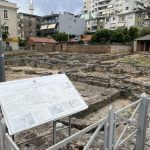
The impressive remains of a 5th or 6th century AD synagogue were uncovered in 2003. Initial excavations at the site were conducted some 20 years ago when Albania was under tight Communist rule. However, the remains of this religious structure saw the light during joint excavations by the Albanian Academy of Sciences and the Hebrew University Institute of Archaeology.
The archaeologists discovered that the synagogue underwent various periods of use, including its conversion into a church at its last stage. Particularly noteworthy among the finds are two mosaic pavements. At the center of one of them is a seven-branched candelabrum, flanked by a citron (a fruit similar to a lemon) plus a ram’s horn – all symbols associated with the Jewish holidays. The other mosaic pavement includes a variety of animals, trees, and symbols alluding to Biblical lore, together with the facade of a structure resembling a temple (possibly a shrine for the Torah). The excavators have also found other mosaic pavements, which pre-date the building of the synagogue.
In coming years the archaeologists hope to continue excavations and investigate other parts of the synagogue that remain covered by modern buildings and streets.
The building dates from the 5th or 6th century, and is the first ancient synagogue known in Albania. Remains of synagogues of other Late Antique Jewish communities are known from elsewhere in the Balkans and south-eastern Europe (for example at Plovdiv, Bulgaria and Stobi, Macedonia) and in Southern Italy (Bova Marina and Venosa).
According to archaeologists Gideon Foerster and Ehud Netzer of the Hebrew University of Jerusalem, ‘five stages were identified in the history of the site. In the two early stages fine mosaic pavements (2nd to 4th century), probably part of a private home, preceded the later synagogue and church. In the third stage several rooms were added, the largest of these containing a mosaic pavement representing in its centre a menorah flanked by a shofar (ram’s horn) and an etrog (citron), all symbols associated with Jewish festivals. Mosaic pavements also decorated the other rooms. A large basilical hall added in the last two stages of the history of the site (5th to 6th century) represents the heyday of the Jewish community of Anchiasmon (Onchesmos), the ancient name of Saranda’. The structure measures 20 by 24 metres and was probably last used in the 6th century as a church, as evidenced by two dedicatory inscriptions in the mosaic pavement.