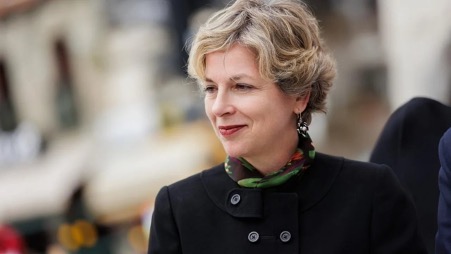
A well-thought selection from the art collection of Ludwig Museum, Budapest, will be displayed this Friday at Albania’s National Gallery of Arts. The exhibition, entitled “Ideals and Artworks” , will be opened at 7pm in the presence of the Albanian Culture Minister, Mirela Kumbaro, Hungary’s Ambassador to Tirana, Antal Heizer and Jàºlia Fabà©nyi, director of the Ludwig Museum.
On this occassion, Fabà©nyi has given an exclusive interview for Tirana Times highlighting that ” this exhibition and the Albanian art collection, which will be displayed in Budapest on July 14th, will fill a void, presenting the art of Hungary and Albania —and by this the countries themselves, including Kosovo, as well—previously unknown to the audience.”
She expressed her hope that both exhibitions will become a point of reference for anyone interested in contemporary art.
It sounds like Albania and Hungary share comparable art sentiments. Please how would you characterize the first exchange between Hungary’s Ludwig Museum and National Gallery of Art of Albania and why Albania art scene had not stirred any interest so far?
Following the 1989 regime change, Hungary’scultural relationship with the countries of East-Central-Europe was the closest; art from Albania was regarded as part of the context of the Balkans. Post-socialist countries were primarily preoccupied with catching the attention of the West and trying to enter the international art scene; direct, official contact between these countries was rare.
The two exhibitions rely on the mutual professional interest and affinity, with no external constraint or official expectation. They fill a void, presenting the art of Hungary and Albania—and by this the countries themselves, including Kosovo, as well—previously unknown to the audience.
Where might this cooperation lead in your view?
The two exhibitions and the catalogues joining them offer an opportunity for the previously unknown artists and their achievements—introduced by the curators—to get in the center of attention. We hope that both exhibitions will become a point of reference for anyone interested in contemporary art.
I am interested to know some interesting facts about this collection and about the process of bringing it here. What did it take? I guess a challenge in its own…
The curatorial selection for the exhibition in Tirana departed from the permanent display of Ludwig Museum; the exhibition entitled Ludwig 25presents the art following the 1989 regime change, the so-called post-socialist period. Established with the Ludwigs’ donation, the museum’s collection is of a much broader range both in terms of interests and subject areas; however, to introduce Hungarian artists in an exhibition today in Tirana, we decided that the best would be to select works that address the recent past. This partially relates to the Socialist Realist exhibition on display in the Albanian National Gallery of Arts.
How can this art collection inspire Albanians with some of Hungary’s greatest moments as a nation?
These works are articulations of the freedom and independence of the arts, of an autonomous, critical way of thinking, which finds its forms of expression even at the most difficult times. All the selected artists examine and criticize the theories, desires, and ideologies that shape the society, including the idea of the “nation,” which does not exist in its 19th century meaning anymore, however it remains to be apparent in our relation to language, traditions, and history.
How essential are the researches into the contemporary visual art for one’s society and one’s region?
Its direct connection to our times is what makes contemporary art relevant, the context in which it is produced. As a contemporary art museum, our mission is to collect and present works of art that address questions relating the people and society of today, thus making a contribution—in their own ways—in understanding different phenomena and resolving certain problems.
What would you like Albanian visitors to gain from a visit to this eliteexhibition? What should they expect to learn from it?
We think that the theories, ideologies, and conceptions of the 20th century introduced at the exhibition are familiar to the Albanian audience, as well as the social-political changes of 1989 with their consequences experienced even today. There is no moral of this exhibition, as art does not offer direct answers. Our intention with the selection was to reveal the exterior and interior forces shaping our lives and demonstrate critical artistic positions that are free of these constraints.
What do you consider to be the most exceptional art piece in this collection?
The most valuable works in the Ludwig Museum’s collection are, without doubt, the Pop art pieces and the Picasso paintings—these were parts of the Ludwigs’ 1989 donation to Hungary. The importance of the section consisting of Hungarian and Eastern-European works lies in the fact that it sheds light on the peculiar characteristics of the region’s art practices, something the Western narrative of art historystarted to discover only recently.
It’s hard to pick out one work from the Tirana selection; Cotton-pickers in Kazakhstan, a painting by Là¡szlà³ Lakner, is one of the best illustrations of the unique artistic strategies employed by Hungarian artists in the 1970s, living in the East but turning toward the West. The painting has several layers of meaning: although formally it follows Western trends, it gives a critique of the power of socialist propaganda.
Why do you believe museums in general and Ludwig museums in particular are valuable in today’s world?
Museums face several challenges in the 21st century: the struggle for the audience’s attention means offering an attractive and diverse program that is professionally sophisticatedat the same time. A museum is a place for education, entertainment, and relaxation; a public space—in response to the demands of the audience—that employs contemporary art as a vehicle to have its effect on individuals and the whole of society.
What has been the most notable project you have worked on?
In 2015 our museum organized the exhibition Ludwig Goes POP + The East Side Story, which displayed the Western-European and American Pop art collections of the Ludwig Museums along with works from our region of the same time. The exhibition was a huge success, drawing attention to the achievements of Eastern-European art once again, reinforcing us in our determination to collect art from the former Eastern Bloc in the broadest range possible, and present it locally and internationally as well.
(Interviewed by Rudina Hoxha)