Artan P쳮aska
apernaska@tiranatimes.com
As the Spanish translator and literator received the title of Comendator of the Order of Civil Merit, Artan P쳮aska, from Tirana Times, met with Ramon Sanchez Lizarralde and asked him how may it be that he learned the Albanian language and later became a renowned translator?
Ramon Sanchez Lizarralde: I had no previous knowledge of the language. I became acquainted with Albanian when I arrived in the country. That was back in the eighties. In Spain, I was at that time a member of a party that was not legal. Spain did not have an Albanian embassy, and I went to the embassy of Albania in Paris. Then I travelled from Paris to Belgrade and then to Tirana, where I worked with the 8 N쯴ori publishing house and Radio Tirana.
What was the 8 N쯴ori publishing house and the Albanian editors translating at that time?
Mainly works from Enver Hoxha, like The Anglo-American Threat, The Childhood Years, etc. At that time there were also two propagandistic magazines, Albania Today and New Albania which also appeared in Spanish.
At the same time, Aurel Plasari, Xhevahir Spahiu, etc. were rendering pieces of Spanish literature in Albanian in publications such as the literary newspaper Drita, and the literary review, N쯴ori , and I remember to have myself contributed with some translations.
What were the first literary translations from Albanian to Spanish?
The first literary work that was translated from Albanian to Spanish was The General of the Dead Army the famous book by Ismail Kadare. It was published in the years ’87-’88 by a small publishing house, (Ediciones VOSA), that I had created.
Then The Broken April was the first translation that had a wider commercial diffusion. It was edited by a renowned publishing company.
Before that, The Siege had been translated from its former translation in French.
After The Broken April, other translations of well-known works by Ismail Kadare followed, like The Big Pashalics, Chronicle in Stone, etc. In a long period of time, I have translated into Spanish almost thirty books written by Ismail Kadare, mainly in prose.
But I have also translated other authors and prose-works like The Fiesta of Xhelaledin Bey and other short stories by Mitrush Kuteli and two volumes of Albanian Folk Tales.
Out of the contemporary writers, I have also translated Mimoza Ahmeti, Gentian ȯ谬i, Ervin Hatibi and Agron Tufa. The three latter authors were published together in a selection of some of their poetical works. It came out of print four or five years ago.
I have also translated and made dossiers on Albanian literature in Spanish literary publications, presenting authors like Bashkim Shehu, Zija ȥla, Bardhyl Londo, etc.
Recently the translation of The Dog’s Hide, by Fatos Kongoli became available for the Spanish readers, and two more novels from this author will be available in the future.
All the while, I have also tried to aid the Spanish readers to get insights into Albania and have been present in the Spanish press, El Pais, El Mundo, etc., with articles and essays. Some of them were consecrated to the political situation. Political not in the narrow sense of the word, but with insights into subjects such as the Albanian emigration breakthrough, the pyramidal schemes of investments, and with thoughts on the issue of Kosov묠in which point my ideas have differed from a part of the Spanish public opinion.
You have given life for the Spanish reader to a long list of translations from the renowned Albanian writer Ismail Kadare. Most of them are prose translations. Have you ever attempted to translate Kadare’s corpus of poetical works, which is one of the finest poetical corpuses of the Albanian language? Is the translation of poetry a more elaborate task?
I have already translated a large selection of Kadare’s poetical work. A volume of almost 300 pages is ready for publication and waiting for an interested editor. But you should realize that the publication of such a large volume of poetry is not easy to be undertaken by a publisher, who will consider minutely the risks of successful or unsuccessful sales of a poetry book.
I have also translated and published lumps from the Albanian Legendary Epics.
As far as the translation of poetical works, sometimes the task is purely Sisyphean. At a certain moment, I tried to translate poetical works by Lasgush Poradeci, the great lyrical Albanian writer, but I was not a match to that task. It became impossible for me to convey his lyrical work in Spanish. So at last, I gave up. At times, it is merely impossible.
Have you ever translated works written by the Albanian authors from Kosov롯r Macedonia?
Yes I have done so, but not in the form of a book. I mainly translated something from a poet from Kosov묠[Xhevdet Bajraj], at the time that he came to Mexico with the help of the World Parliament of Writers. It was in the troubled times of the war in the country.
I have translated Ismail Kadare’s diary on Kosov묠as well as participated with translations from the Albanian language or presentations in a huge, over 600-page book on the issue of Kosov묠published in Spanish to give an all-embracing view of the question. Serb as well as Albanian points of view were represented in the book, which also included a translation of the documents of the Academy of Sciences of Serbia, which had called for an eradication of the Albanians from Kosov묠earlier even than the Miloshevi硲egime overtly executed these politics.
This was one of my contributions to the Spanish public opinion who knew little about the issue and was easily seduced by Miloshevi稳 demagogy.
In what circumstances were you honored by honor of the Order of Civil Merit decoration?
This is a decoration given by the King of Spain. The Spanish Ambassador in Tirana had recommended my contribution to the development of literary bridgework between the two countries. I received the honors on the 24th of April, the day after the death anniversary of Miguel Cervantes (23.04.2009 – Day of Spanish Literature also International Book Day).
INSERT
/
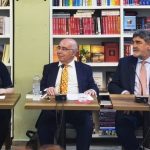
On the 23rd of April in Tirana, the Albanian auditors had attended to a presentation of the translation of the book Fatos Kongoli’s The Dog’s Hide, translated by Lizarralde and the presentation of the recent publication in Albanian of his own book titled Albania in the mirror of literature.
/
The Comendator of the Order of Civil Merit (Encomienda de la Orden del M곩to Civil) is a very old decoration, mainly for foreigners or Spanish officials that have rendered particular services to Spain. I received this decoration for my lifelong contribution in translation and in making the Albanian literature known in Spain and, through this literary engagement, for the strengthening of the Spanish-Albanian friendship.