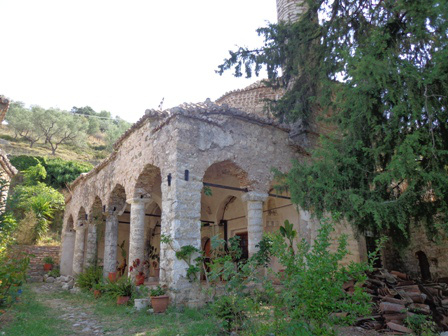
TIRANA, Aug. 13 – The Gjin Aleksi mosque in the southern district of Delvina could be unique in the world for its name. Featuring a Catholic name (Gjin) and an Orthodox surname and name (Aleksi) the mosque is one of the best examples of Albania’s religious co-existence.
The 17th century mosque, is a first category monument of culture, but has been little promoted as a tourist destination although it is situated only 16 km from both the popular coastal city of Saranda and the Syri i Kalter (Blue Eye) spring, local media report.
A local encyclopedia shows that the mosque was built over the ruins of a church in the 17th century but says nothing about its name.
Local people believe the version that Gjin was a Catholic converted into Muslim who turned the church into a mosque during Albania’s Ottoman occupation.
The mosque, its minaret and portico stand on top of a small terraced hill, in the middle of a circuit of four turbe-s (tombs) of slightly different dimensions, all of them hexagonal in clumsy and irregular design, distributed on different levels of the terrain, says Gianclaudio Macchiarella of the Centre for Balkan and International Studies of the University of Venice in his study “Delvina, a mystic architectural enclave.”
The mosque is square with a single open space hall of about 8 m. The qibla wall is framed by an elegant niche with muqarnas decoration. An upper wooden gallery, supported by a diaphragm masonry wall on a couple of small columns, precedes the main hall and can be accessed through the spiral staircase of the minaret on the northwestern corner of the building.
The large dome rests on a tall octagonal drum where a large band, running through the circumference of the dome, is decorated by a painted inscription in Arabic. Despite the scant information on the building and the complex, this element supports the hypothesis that the original function of the mosque with its surroundings, was that of a center of pilgrimage and learning. The so-called “graffiti” recently found behind the right and left semi-columns at the entrance door of the mosque could help in dating the monument and its two building phases. The first pertains to the construction of the prayer hall, the second to the addition of the portico. While the domed prayer hall shares common features with other Albanian mosques of the 16th
and 17thc., its portico suggests, both in plan and elevation, a possible relationship with the typology of some Bosnian mosques, like the Handanija mosque in Prusac (d. 1617).
The sophistication of the mosque design along with the good level of workmanship, the choice of the dome Quranic inscription and the mystic interpretation of some of the inscriptions found at the entrance, reveals an elevated cultural background which could lead to dating the main building to the 3rd quarter of the 16th c., followed by the addition, in the first quarter of the 17th c., of the vaulted portico.
Religion in Albania
Four Albanian religious leaders travelled to Paris to march in the solidarity rally paying tribute to the victims of terrorist attacks at the offices of satirical magazine Charlie Hebdo last January. Their hand-to-hand march as evidence of the religious harmony in Albania was applauded by French citizens for several minutes.
Pope Francis who picked Albania as his first European destination to visit last September condemned the terrorist attacks which left more than a dozen dead, bringing the example of Albania where different faiths coexist in peace.
“I experienced an eloquent sign that the culture of encounter is possible during my visit to Albania, a nation full of young people who represent hope for the future. Despite the painful events of its recent history, the country is marked by the ‘peaceful coexistence and collaboration that exists among followers of different religions,” said the Pope addressing members of the diplomatic corps accredited to the Holy See.
Albania’s religious harmony is praised in different reports as an example to be followed. Albania is considered the only country in the world where the number of Jews after the Second World War was larger than before the war.
“There were no reports of societal abuses or discrimination based on religious affiliation, belief, or practice,” said the U.S State department about Albania in its 2013 international religious freedom report.
According to the latest 2011 census, Sunni Muslims constitute nearly 57 percent of the population, Roman Catholics 10 percent, Orthodox Christians (the Autocephalous Orthodox Church of Albania) nearly 7 percent, and Bektashi (a form of Shia Sufism) 2 percent. The Roman Catholic and Orthodox Churches and Bektashi representatives all maintain that their numbers are underrepresented in the official census. Other groups present include Bahais, Jehovah’s Witnesses, and The Church of Jesus Christ of Latter-day Saints (Mormons). The State Committee on Cults reports more than 220 religious groups, organizations, foundations, and educational institutions operating in the country.
Albania’s communist government had outlawed all religion and religious activities in 1967, making Albania the first officially atheist country in the world. Religion was restored in the early 1990s just before the collapse of the communist regime.