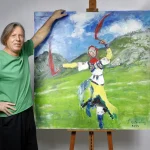
An Albanian painter from Kosovo, famous mostly in Austria, opened up an exhibition for the Albanian public. Although not much known in Albania or Kosovo, he is at the peak of his career abroad, especially in Austria and Germany. The exhibition will stay open from November 19th to December 17th at the National Art Gallery and represents a great recognition of Dalip Kryeziu’s art. It is the largest exhibition of his works, which are not only retrospective hosts.
Dalip Kryeziu was born in Bubavec, Kosovo. He spent his childhood in a rural environment. After he completed his elementary studies his whole family moved to Klina, where he went to secondary school. He started drawing at eleven years old, but the art vocation became stronger under the influence of his uncle, a professional painter.
After he completed higher education in an English university in Prishtina, he traveled around Europe to finally settle down in Austria. He has taken part in many international exhibitions and art shows such as the International Biennale of Contemporary Art in Florence (1997), The Art Fiera Cornice in Venice (2007) and The Prague Biennale (2009). His works are also exhibited in the following art collections: Museum der Moderne Salzburg, Oberhessisches Museum Gieࠥn, Allianz Hamburg, Deutsche Bank, Crꥩt Suisse. Kryeziu lives in Frankfurt am Main since 2006.
Dr. Michaela Preiner review of Kryeziu’s work
Dalip’s search for new expressive possibilities and extensions of their own repertoire inevitably led him to work with the computer, which he reinforced in his work. The construction and deconstruction of images and the simultaneous storage and data destruction indicates that the tension of Dalip Kryeziu’s artwork extended not only technically, but also expands his artwork in the broad field of modern media theory. The theoretical preoccupation with the function of art, questioning the eligibility of an artistic handwriting and the new imperative of their own art inevitably raises a number of questions. Dalip’s work will take place due to the current discussion of these issues likely to expand and /or modify. The art of Dalip will go a major step forward with this new development in his work.
The Kopfmotiv
The “Kopfmotiv” runs like a thread through his work as well as his so called diary records. He tries with the first a personal interpretation of a millennia-old theme of art history to go apart from role models and to solve its own access to find out which allows him to formulate some generally admitted points of view about humans, so he pursued with the revision his diary sketches an opposite way. Thus he holds the first of his creative process in his own artistic language that stated what he saw, heard and experienced. The initial information, the original, spontaneous impulse, which he expresses in the first step on the small drawing, in a second trial rearranged on the canvas in a new reference system finally brought a new gesture to be revised. This gives each piece of art several dimensions, not only formal but also substantive. Either it’s a brilliant way to narrate stories in a very traditional way of telling it linear and comprehend or, the templates according to purely aesthetic point of view and is applied to a whole new story without any claim to logical comprehensibility of the stories, but purely aesthetic considerations.