TIRANA, Jan. 19 – After its success at the Venice Biennale, the “Potential Monuments of Unrealised Futures” exhibition has travelled to London where it is being displayed at the Architectural Association School of Architecture.
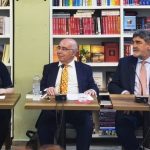
Prime Minister Edi Rama an artist turned politician, who was a special guest at the exhibition’s opening ceremony, described the event as another opportunity “to confess again with words and works Albania which is being recognized from a different perspective.”
“At the famous Architectural Association international school where the exhibition of the Albanian pavilion at the Venice Biennale attracted huge interest, followed by a debate on the power of the beauty on the social and economic development,” wrote Prime Minister Edi Rama on his Facebook profile, also posting some pictures of the event.
Sadie Morgan, the President of the Architectural Association (AA), described the event as an excellent opportunity to further strengthen cultural exchanges between Albania and the UK.
Potential Monuments of Unrealised Futures presents work by two Albanian artists, Edi Hila and Adrian Paci. Curated by Beyond Entropy Balkans (Jonida Turani and Stefano Rabolli Pansera), this exhibition was originally commissioned by the Ministry of Culture for the Pavilion of the Republic of Albania at the 14th International Architecture Exhibition, Venice Biennale 2014.
“The exhibition explores how modernity can be absorbed through a reflection on the social and cultural dynamics presented in the work of the two artists. The unrealised futures are the promises of modernity; partially realised, but yet not completed,” curators say.
Focusing their gaze on buildings, the processes of construction and unfinished architectural elements, the artists avoid the traditional architectural viewpoint. In the potential created by the fragmented and uncompleted plans, lie the conditions of a new concept of potentiality considered as a value to be preserved. Maintaining this potential suggests another direction for political and architectural action.
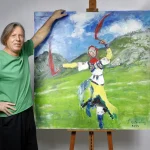
In the series Penthouse, Edi Hila envisages the domestic architecture dispersed in the Albanian landscape. The constructions, elevated onto plinths, become imagined architectures loaded with monumental elements: arches, pediments and pilasters. The paintings reveal a conceptual model for transforming the traces of modernity into potential monuments.
The Column by Adrian Paci is articulated in two elements: the projection of a video inside the AA Gallery and a column resting horizontally outside the exhibition space in Bedford Square. The video documents the transformation of a block of marble into a Corinthian column inside a factory-ship on the ocean. The column, a universal architectural element, emerges from the labour of a group of workers who, covered in dust, become an extension of the sculpture. Once completed, the column is detached from this context of production and is not erected but remains horizontal, in a state of impotence and potential.
“This is not a didactic exhibition of the movements in Albanian architectural history, it is not an encyclopedic catalogue of Albanian architecture, rather the pavilion provides the occasion to develop a standpoint to understand Albanian architecture today,” said Jonida Turrani and Stefano Rabolli Pansera, the curators of the Albanian pavilion.
“Through a multimedia exploration of modernism, the artists weave real and constructed references, past and present, fictional stories, and form readings of such buildings beyond the traditional lexicon of architectural representation,” added the curators.
Born in Shkodra, Edi Hila, 70, has a career that spans across several decades, having managed to survive political disillusion, persecution and censorship throughout. The ‘70s were a difficult period for the artist, having been restrained from producing art under communism. The Albanian transition to capitalism has been equally challenging in many ways as it emerges in the latest work focusing on the urban conditions and on the socio-cultural dynamics of late capitalism.
Meanwhile, Adrian Paci is an internationally renowned artist born in Shkoder in 1969. A considerable part of the work of Adrian Paci is dedicated to the theme of loss, abandonment of his land to deal with the new realities. Argument developed from the experience of migration, expressed through the story of memory, current topic and universal, embracing the conditions of all emigrants.
The exhibition in London will remain open to the public until March 12.