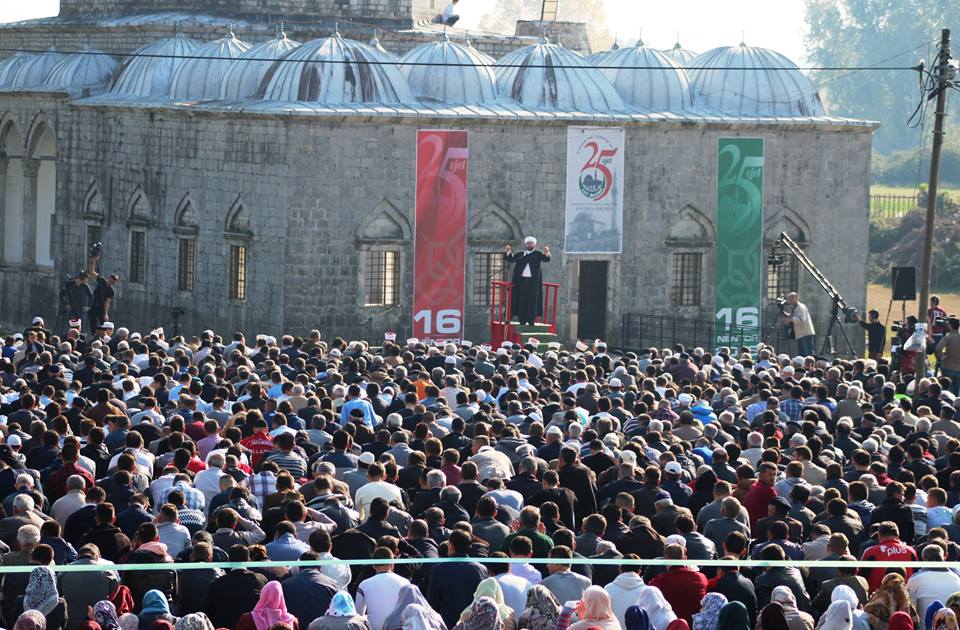
TIRANA, Nov. 16 – Albania’s Muslim community has marked the 25th anniversary of the reopening of the Lead Mosque in the northern Albanian city of Shkodra, where Albanian Muslims held their first public prayer in late 1990 just as the country’s communist regime was collapsing after more than two decades of a ban and persecution on religion.
Thousands of believers gathered for the Friday Prayer last week at the 18th century Xhamia e Plumbit (Lead Mosque) which was one of the few religious monuments spared by the communist authorities who destroyed and misappropriated most religious sites and persecuted religious clerics.
Shkodra Mufti Muhamed Sytari paid tribute to local Muslims who participated in the great movement for the reopening of the Lead Mosque, which he said was the only mosque which remained untouched after 23 years of persecution and violence against religion in Albania.
“In this atmosphere of freedom to religion, in this jubilee 25th anniversary of the reopening of our mosques and madrasas, it is our duty to spread the teachings of Quran especially those related to national harmony, rule of law, and distance ourselves from the violence, terror and extremism which have no religion,” said the Mufti.
In another event later on Nov. 14, a conference marked 25 years of “belief, challenges, ordeals and perspectives” after the collapse of the communist regime.
The reopening of the Lead Mosque on Nov. 16, 1990, came few days after a priest in the northern Albanian city of Shkodra held the first Mass after half a century of unprecedented atheism and state persecution against religion.
Back in 2013, the 18th century Lead Mosque in the northern Albanian city of Shkodra was announced as one of the world’s 50 amazing mosques, according to an article published on the Huffington Post. The Lead Mosque, locally known as the Xhamia e Plumbit, was ranked 37th in the 50-mosque list.
Built in the 1700s, this is one of the few mosques that were not destroyed around 1967, when Enver Hoxha’s communist government declared Albania an “atheistic country” and banned all religious meetings and literature.
Located behind the Rozafa Castle, the Lead Mosque was built in 1773 by Mehmet Pasha Bushati and is one of the most prominent cultural and religious monuments in the city of Shkodra. Of particular significance, is its architectural similarity to the Blue Mosque in Istanbul. This distinguishes it from other mosques in Albania, which were designed and built based on typical Arabic architectural styles.
Albania is hailed as an example of religious harmony and has been selected as a venue promoting interfaith dialogue in many international events.
Muslims make up about 59 percent of Albania’s population, with Catholics and Orthodox Christians making up the rest of the religious population.
Albania’s communist government had outlawed all religion and religious activities in 1967, making Albania the first officially atheist country in the world. Religion was restored in the early 1990s just before the collapse of the communist regime.