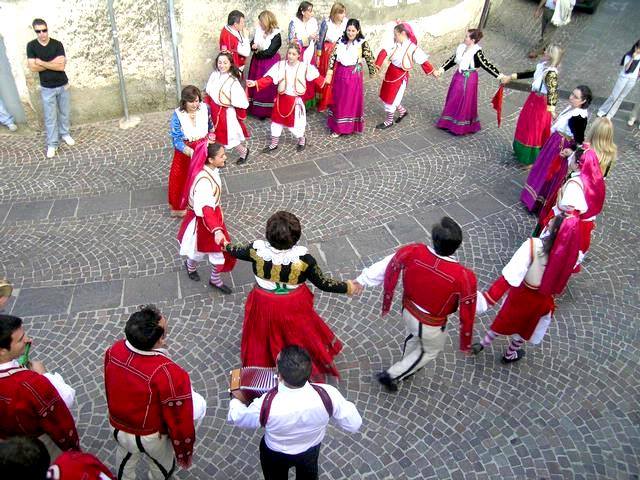
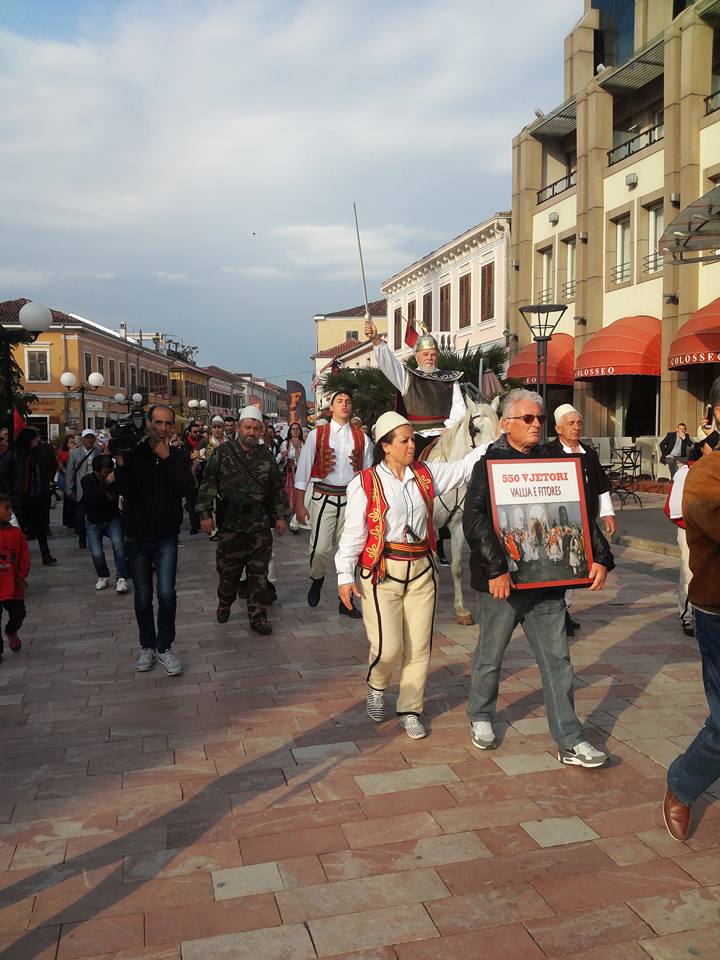
TIRANA, April 25 – More than fifty representatives of the Albanian Arberesh community in southern Italy have toured Albania for three days displaying traditional costumes, dances and songs which they have preserved for more than five centuries since the Skanderbeg era when they fled the country following the Ottoman occupation. The manifestation comes as they lobby to get UNESCO protection as intangible cultural heritage for their Arberesh community of about 90,000 speakers on the 550th anniversary of the last victorious battle of Skanderbeg against the Ottomans.
For more than five centuries, the Arberesh community has been celebrating April 24 with a so-called “Victory Dance” in remembrance of the last victory of the Albanian army led by national hero Skanderbeg against the Ottomans. The tradition marks the April 24, 1467 victory in Kruja after a prolonged siege by the Ottoman army.
For 25 years, Albania’s national hero Skanderbeg kept the Ottomans away from Albania and Europe but his death in 1468 and the Ottoman occupation led to thousands fleeing the country and seeking refuge in southern Italy.
More than five centuries on, Skanderbeg’s figure is still seen a symbol of national unity. Skanderbeg also inspired the late 19th century Albanian Renaissance Independence movement leading to the country’s independence from the Ottoman Empire after five centuries of occupation.
“We seek support as a community belonging to the Albanian national culture, political support to uphold our proposal so that this community is recognized by UNESCO as intangible cultural heritage,” says Arberesh researcher Matteo Mandala, who heads the Albanology department of the University of Palermo.
The Arberesh language, traditions as well as cultural and natural heritage is considered unique among all minorities in Italy and around Europe.
“We have been working on a platform which we will officially unveil and based on this master plan we will seek the assistance of the Albanian and Kosovo governments,” Mandela has said.
Local government Arberesh officials in southern Italy called on the Albanian government to help preserve their culture.
“I am very happy to meet my brothers across the Adriatic. We are coming here to establish communication bridges between people and cultures. It is true that Albanians understand Italian, but what we have to do is preserve even the Albanian language and even Albanian institutions and government have to work on this,” says NoਠAndreano, the head of Casalvecchio di Puglia commune.
“We see history here and we have to learn from each other. It is important being united as ‘unity makes strength’ as Skanderbeg put it,” he adds.
In their three-day tour to Albania from April 22 to 24, the Arberesh representatives visited Kruja, the stronghold of Albanian resistance against the Ottomans for more than two decades under Skanderbeg leadership, as well as the castle of Lezha and its Skanderbeg memorial tomb, Shkodra and its Rozafa castle and the castle at the Cape of Rodon outside Durres
UNESCO which has granted protection to three Albania sites, already recognizes Albanian iso-polyphony music as a masterpiece of the Oral and Intangible Cultural Heritage of Humanity.
Preserving Arberesh language, culture
Arberesh community members have warned the archaic Albanian language that the Arberesh community in southern Italy has preserved for more than 500 years is in danger of extinction in some community areas, especially among younger generations.
“We preserved the Arberesh language for 500 years, now it is you who should do something for us. To the Arberesh people, Albania is a country where they nostalgically return, but today’s challenges are tougher and stronger cooperation is required so that the special ties remain strong,” Lucia Martino, the president of the “Vorea” Arberesh Association in Frachineto, Calabria, has earlier said.
“I have two nieces who don’t speak Arberesh because it is not taught at school. It is very important that they learn it at school because only this way they can come into contact with the language and preserve our language and culture,” Martino, an activist of Albanian language has told local Albanian media.
“We still preserve some dishes and costumes Albania no longer has,” says Martino, who is promoting the learning of Albanian among the younger generation through theatrical ‘performances and tours as more effective methods to attract their attention.
As a linguistic group, the Arbà«resh now consist of about 90,000 speakers, most of whom live in the mountain villages of Cosenza in Calabria and in the vicinity of Palermo in Sicily. The Arbà«resh speak an archaic dialect of Albanian, which differs substantially from the Albanian now spoken in the Balkans, to the extent that communication is difficult if Arbà«resh speakers are not familiar with standard literary Albanian, says Robert Elsie, a Canadian specialist in Albanian studies.
However, Italian is gaining the upper hand even in often isolated mountain Arberesh villages of southern Italy.
“In a number of communities, Albanian is still spoken by virtually all the inhabitants. In other settlements, the adult population is bilingual and the children speak only Italian. In still other communities, it is only the old people who understand Albanian,” says Elsie.
According to him, several factors have contributed to the gradual transition from Albanian to Italian in these villages including the compulsory use of Italian in all schools, the lack of support by the Italian government, the discontinuity of Albanian-speaking territory, the Italian-language mass media and, in particular, seasonal emigration due to chronic unemployment in southern Italy.
The Arberesh are not to be confused with the large numbers of new Albanian immigrants who have arrived from the Balkans to settle throughout Italy in the last two decades.
Italy is Albania’s main trading partner and the host of some 500,000 Albanian migrants in the past 25 years of transition to democracy. Regular daily trips connect the two countries by sea and air while a considerable number of Italians have also moved to Albania to study, work but also do business.