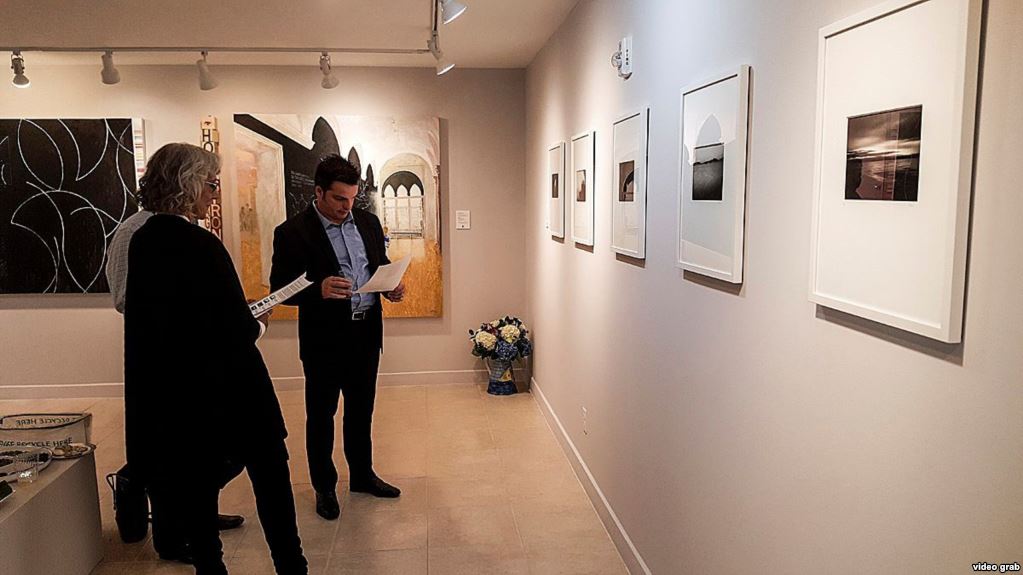
The GR Art gallery opened its doors for the first time in March this year with a Marubi photo-exhibition. The gallery, established by the Albanian-German painter Gjergj Pali will now introduce art-lovers with a new exhibition of paintings and artworks by 11 authors. As an organizer, Pali has selected a collection of figurative art works that represent a variety of mediums, styles and worldviews.
Seemingly different in style, and in medium, the works have been selected to fit the exhibition’s theme, Structured Images and More. Pali got the idea for the theme after beginning to choose among the exhibited works.
“It was a general specific attribute in which the image goes from the second dimension to the third dimension, it becomes three-dimensional. And it lives on through the painting; it almost becomes a painted sculpture,” Pali has told the Voice of America.
In some cases the structure is not a physical element of the artwork, but rather consists in the metaphor that it transmits. The painter Adriatik Baliaj is one of the artists whose artwork will be exhibited in the gallery.
“Snow changes the structure of a place; if it is dark, it changes the color, but it also changes the shape. If seen poetically, it is reminiscent of a structure,” Baliaj said.
Another artist, Gazmend Bakalli, finds that his inspiration grows from the rites and ethnographic elements of his hometown.
“This is the Shkodra bride,” he said for one of his paintings. “It is fully based in Shkodra’s history and on how old brides have done in Shkodra. The structure is primarily based on the material of old costumes, while the old Shkodra houses have the same structure more or less, the structure than now seems to be in our blood. All these elements, intentionally or unintentionally, penetrate the painting and are mirrored in it.”
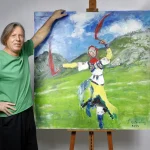
Gjergj Pali, as a painter, has chosen to enter the memory structure with one of his works belonging to the Memories’ Zone circle, with elementary school scenery that reminds him of his childhood but also serves as a parallel to his life:
“It is abandoned because we abandoned our country. The love remains, and surely from time to time it manifests in memories, through threes, crows, it is almost reminiscent of a dream…somewhere between reality and a dream.”
The art historian Zen Paci has formerly collaborated with the gallery owner to organize the Marubi exhibition. As opposed to that exhibition, which was centered on the art of photography, this time the artists have brought a variety of styles, techniques and content, which in a way are a synthesis of the American experience in itself.
“It is an environment that welcomes influences, worldviews and different cultures, maybe similar to the country that hosts it,” Paci said.
Amid this variety of artistic styles, the works of American-Albanian painters bear their own artistic identity.
“We have our own particularities. You can tell our paintings from a painting made by someone born here, it was shaped in school. It is noticeable that we are more figurative because of the school we attended, and the tendency was towards the art of realistic socialism at that period, which shaped the classical painting formation,” Pali added.
Pali said that all artists representing that time period now have a steady address where they can be introduced with the art-lovers, as well as a centre where Albanian culture in this side of America is preserved and cultivated.
“All that you’ve known, learned, and memorized there, in cooperation with everything present, create a new state, a state that is different and interesting, more inspiring for future creativity,” Baliaj said.
It took Gjergj Pali, an artist from Shkodra who managed to flee the country in the late 1980s and has been living in the U.S. ever since, opening dozens of exhibitions, a long way of sacrifices and adventures to get where he is now, yet he believes that the destination deserved every sacrifice.
“No profession is more beautiful. It is a tough profession, without a doubt, but I always tell the same thing to my friends, if I’m brought to life another time I want to be an artist again…maybe in Shkoder, maybe here, but the profession is more important to me, the place doesn’t matter,” he concluded.