Tirana Times
TIRANA, March 8 – The international women’s day Tuesday in Albania was exploited from both political groupings _ governing Democratic Party of Prime Minister Sali Berisha and main opposition Socialist Party of Tirana Mayor Edi Rama _ as another step in their ever-squabbling political fight.
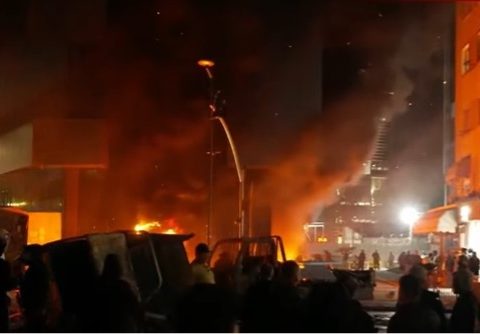
A couple of thousands of opposition supporters listened to speeches held from their leaders in front of the premier’s office while about the same number of a cheering crowd took part at a government’s ceremony a couple of hundreds of meters away at the hall of the Palace of Congresses where Berisha hailed his government’s achievements. Albania holds local authorities’ elections May 8 amidst a tense political situation following their deadly protest of Jan. 21 when four were shot dead and dozens of opposition protesters and police were injured in clashes.
The opposition Socialists are demanding that conservative Prime Minister Sali Berisha hold early elections over allegations of corruption and vote rigging in the 2009 general election.
Berisha has refused to resign, accusing the opposition of trying to stage a coup.
European and U.S. officials have repeatedly called for restraint from both the Socialists and Berisha’s governing Democrats urging them to continue their political fight with the May 8 local elections instead. United Nations urged greater support for gender equality and the empowerment of women in Albania.
United Nations Agencies underline the need for government, civil society, the private sector, the media, and individual women and men to join forces to make the necessary changes to laws, policies, attitudes and behaviours to ensure that all Albanian women fully participate in political, economic and social life.
Domestic violence in Albania remains wide spread. Half of Albanian women report to have suffered some form of abuse while at least 31% have suffered physical abuse, and 13 % sexual abuse. Only 33% of those enrolled in secondary professional education are women. The number of women in Parliament rose from 7% in 2005 to about 16% in 2009. In 2007, less than 3% of those running for the position of mayor were women and of the 33 women nominated only 9 women won. There is only one woman in the Cabinet of Ministers.
Women’s rights are a prerequisite for a country’s development. As the UN Secretary General, Ban Ki-moon states, “Supporting faster progress for women is not only morally right, it makes good political and economic sense.” The World Economic Forum identified strong correlations between progress in gender and GDP per capita growth.
The 100th anniversary of the International Women’s Day marks a renewed commitment by the UN system to accelerate the Organization’s goals on gender equality and the empowerment of women with the establishment of UN Women officially launched on February 24th. This new UN agency merges and builds on the valuable work of four previously distinct parts of the UN system, bringing together resources, expertise and mandates for greater impact.
Respecting human rights means respecting women’s rights. Albania is a state party to the Convention on the Elimination of All Forms of Discrimination against Women (CEDAW). As part of national commitments to achieve Millennium Development Goal (MDG) 3, to promote gender equality and empower women, it is well recognised that the achievement of this goal is central to the achievement of all the MDGs. Aspiring to join the EU, Albania is committed to the Council of Europe standards and approaches on non-discrimination including equal treatment of men and women, public participation in decision-making, and support to civil society. The UN encourages Albania to stand up to all of these commitments.
Albania has made great strides to put in place laws and policies for gender equality. This includes the law on Gender Equality in Society, which provides for 30% quota of representation in decision making bodies. In view of the forthcoming local elections, the UN urges the implementation of these quotas to give true meaning to the rights of women to vote and take part in the conduct of public affairs without discrimination. The UN also calls for the effective monitoring by civil society, government and political parties of the application of these quotas.
The UN also urges the promotion of more gender sensitive attitudes and behaviours through education, raising awareness, and role models. Authorities, people of public life and all citizens should oppose physical and verbal abuse of women. The media has a strong role in the needed behavioural change and the celebration of women’s achievements.