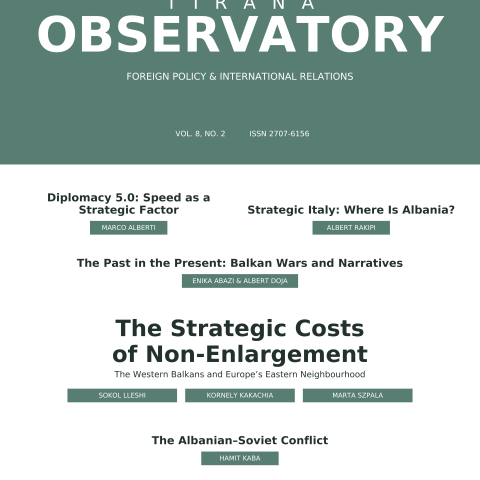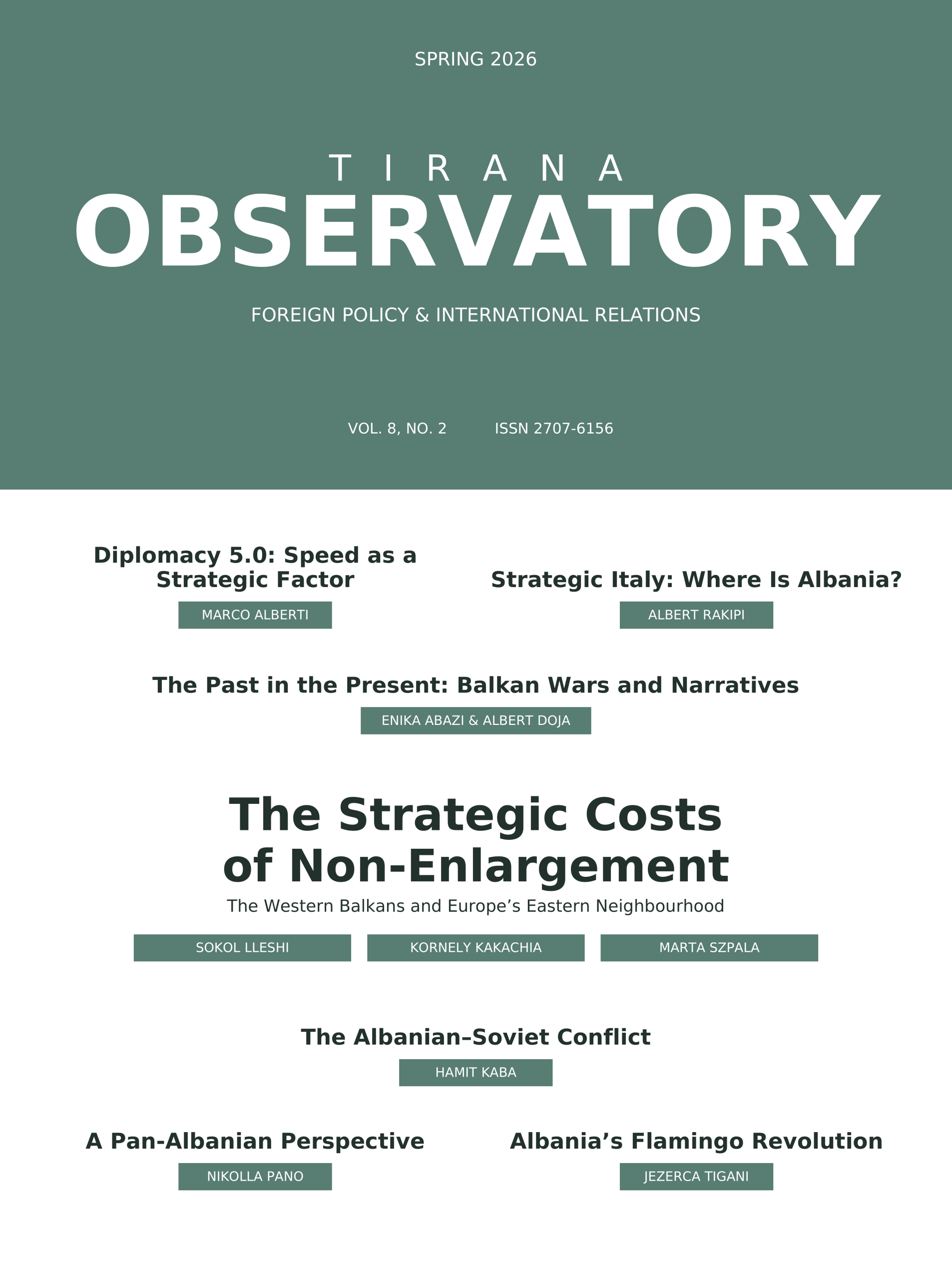
The Spring 2026 edition brings together international scholars, diplomats and policy experts to examine European integration, geopolitical challenges, diplomacy and Albania’s foreign relations.
TIRANA, Albania – The Albanian Institute for International Studies (AIIS) has released the latest issue of Tirana Observatory, its quarterly academic journal of foreign policy and international relations, featuring contributions from prominent Albanian and international scholars, diplomats and policy experts.
Volume 8, No. 2 (Spring 2026) focuses on one of Europe’s most consequential strategic questions: the costs of the European Union’s failure to enlarge. Under the main theme, “The Strategic Costs of Non-Enlargement: The Western Balkans and Europe’s Eastern Neighbourhood,” three scholarly contributions examine the political, economic and security consequences of prolonged uncertainty over EU membership.
Sokol Lleshi, a political scientist at the University of New York Tirana, examines the costs of non-enlargement for the Western Balkans, arguing that prolonged delays weaken the EU’s capacity to promote democratic accountability, institutional reform and political stability while creating opportunities for competing external powers.
Kornely Kakachia, professor of political science at Tbilisi State University and director of the Georgian Institute of Politics, analyzes the consequences of the EU’s uncertain enlargement policy for Ukraine, Moldova and Georgia. His contribution explores the increasingly divergent European trajectories of these countries and the strategic importance of sustained EU engagement in its eastern neighbourhood.
Marta Spalca examines the broader geopolitical implications of non-enlargement for the European Union itself. Drawing on interviews with 12 experts from EU member states, her research argues that enlargement is not merely a policy toward candidate countries but an essential instrument of European security, international influence and strategic credibility.
Together, the three contributions offer an assessment of enlargement as a strategic policy whose success depends on reconciling geopolitical imperatives with democratic standards and institutional reform.
The issue also features an essay by Marco Alberti, Italy’s ambassador to Albania, titled “Diplomacy 5.0: Speed as a Strategic Factor.” Alberti examines how digitalization, artificial intelligence and technological innovation are changing diplomacy, arguing that speed and institutional adaptability have become essential elements of international influence.
In “Strategic Italy: Where Is Albania?”, Albert Rakipi, chairman of AIIS and editor of Tirana Observatory, examines the relationship between Albania and Italy. He argues that despite exceptionally close historical, cultural and economic ties, the two countries have yet to realize the full strategic potential of their partnership. The essay identifies opportunities for deeper cooperation in defense industries, maritime infrastructure, energy, education and technology.
A major academic contribution by Enika Abazi and Albert Doja, “The Past in the Present: Time and Narrative of Balkan Wars in Media Industry and International Politics,” explores how historical narratives, collective memory and media representations have shaped international perceptions of the Balkans. Their research challenges established interpretations of the region’s conflicts and examines the influence of historical narratives on contemporary politics.
Historian Hamit Kaba contributes a study of the Albanian-Soviet conflict of 1960–1961, examining the rupture between Tirana and Moscow through the perspectives of Albania’s neighboring countries and the wider geopolitical circumstances of the Cold War.
The journal’s book section includes an essay by Professor Nikolla Pano, a distinguished historian of Albania and the Balkans, reviewing Elez Biberaj’s Albania and the Albanians on the Path to Recovery, published by AIIS. Pano highlights Biberaj’s contribution to understanding Albania’s political transformation and the historical and political experiences of Albanians across the Balkans.
The current affairs section addresses contemporary political and diplomatic developments. Genc Pollo examines Germany’s evolving approach to EU enlargement and the implications for Albania. Jezerca Tigani analyzes Albania’s Flamingo Revolution and the crisis of political representation, while other contributions examine Albania-Greece relations and the economic and institutional risks associated with Tirana’s construction boom.
The issue also features an article by Nora Ahmeti recounting the origins of the initiative to establish the third campus of the College of Europe in Tirana, an idea developed at AIIS and presented to Prime Minister Edi Rama in December 2022. The account describes how the initiative gained the support of the Albanian government, the College of Europe and European Union leaders.
A Journal Connecting Albanian and International Scholarship
Published by AIIS, Tirana Observatory has established itself as a platform for academic research and informed policy debate on foreign affairs, international relations, security, European integration and the political and economic development of Southeast Europe.
The English-language quarterly brings together contributions from Albanian and international universities, research institutes, diplomatic institutions and policy organizations. Its editorial board includes scholars affiliated with leading academic institutions in Europe and the United States.
The journal seeks to connect rigorous academic analysis with contemporary policy questions, offering perspectives from Albania and the Western Balkans on developments affecting Europe and the wider international system.
Its publisher, the Albanian Institute for International Studies, is one of Albania’s longest-established independent research institutions specializing in foreign policy and international affairs.
Over more than three decades, AIIS has developed an extensive record of academic research, policy analysis, international conferences and publications. Its work has contributed to debates on Albania’s Euro-Atlantic integration, regional cooperation, democratic development and international security.
The Institute has established partnerships with universities, think tanks and international organizations in Europe, the United States and beyond. Since 2023, it has also been part of the European Security and Defence College’s network of academic institutions.
Beyond research and policy analysis, AIIS has contributed to strategic initiatives aimed at strengthening Albania’s international academic and educational connections.
Among its most significant achievements is the conception and development of the proposal to establish the College of Europe’s third campus in Tirana. The initiative, advanced by AIIS Chairman Albert Rakipi and subsequently supported by Prime Minister Edi Rama and European Union leaders, brought one of Europe’s most prestigious postgraduate institutions to the Western Balkans.
Another important initiative has been the proposal to revive the historic French Lycée of Korçë, an institution closely associated with Albania’s educational modernization and its historical ties with France. The initiative was presented to the Albanian government in 2023, while the government’s subsequent efforts to reestablish the school have advanced through the legislative process in 2026.
These projects illustrate the Institute’s broader approach to research and public policy: combining academic scholarship and international cooperation with practical initiatives capable of producing lasting institutional benefits for Albania.
With its latest edition, Tirana Observatory continues this mission, providing a forum for scholarly contributions and policy debate at a time when European security, enlargement and the international order face profound challenges.
The Spring 2026 issue is available through the journal’s website: www.tiranaobservatory.com.