GJIROKASTER, June 19 – Albania’s government has decided to end years of lawlessness in Lazarat, a small enclave in southern Albania often referred to as “Europe’s marijuana capital” for its massive production of cannabis.
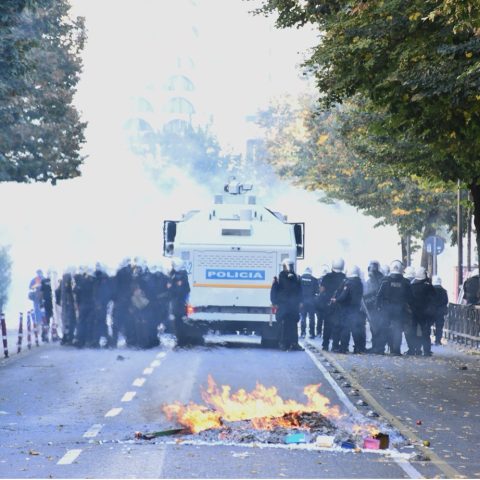
About 800 police officers, backed by armored vehicles, stormed the village Monday in multi-day operation that has netted more than 10 tons of drugs and tens of arrests.
Suspected marijuana growers fired rocket-propelled grenades, mortars and machine guns at officers during the raid, but police advanced slowly capturing much of the village by Thursday afternoon.
At least two police officers and one civilian were wounded during the operation.
Lazarat had become a symbol of lawlessness in Albania and internationally as a no-go area for Albanian police who feared a confrontation with gangs inside the village would lead to loss of life in among officers and residents in the village located 230 kilometers south of Tirana.
Gangs based in Lazarat are believed to produce about 900 metric tons of cannabis a year, worth about 4.5 billion euros ($6.1 billion) נroughly half of the small Balkan country’s GDP. Over the past few weeks, Albanian authorities have launched a nationwide operation to uproot the cannabis plantations as an effort to show Albania is serious in its pledge to fight organized crime as part of its bid to join the European Union.
On Monday, about 500 lightly armed police, including special forces officers and the country’s police chief, surrounded the village of 5,000 overnight after a smaller force was repelled over the weekend. Three hundred other officers and armored personnel carriers joined them later.
A police spokeswoman said officers took control of much of the village after exchanging fire with nearly 30 armed men hiding in a four-story building complex.
A police spokesman said the gunmen fled Lazarat and headed for a nearby mountain, pursued by police. But sporadic gunfire was still heard in the village and it was feared the gangs had left snipers behind.
Authorities advised residents to stay indoors, while scores of police in body armor guarded the entrances to Lazarat.
Interior Minister Saimir Tahiri urged the gunmen to disarm and surrender.
Police destroyed seven plots with some 10,000 cannabis plants and 1,000 young trees ready to be planted. They also found six burnt barrels believed to have stored previously collected drugs and “other considerable amounts of unpacked narcotics.”
Albania’s private A1 channel said its TV crew covering the Lazarat operation was robbed and briefly taken hostage at gunpoint by masked men who also burnt their vehicle.
Marijuana-growing gangs in the village have long seen themselves as beyond the reach of the law. In 2004, shots from the village forced an Italian drug-spotting helicopter to make a hasty retreat.
How Lazarat turned into Europe’s pot capital
Police said a “well-structured group” of about 30 persons resisted to some 800 police surrounding the village, even using rocket-propelled grenades, mortars and heavy machine guns.
They had been organized to defend cannabis production. Law enforcement officials say Lazarat has a long history of lawlessness and is in a good location for drug cultivation because it si close to an EU member country like Greece, or not far from the sea shore of Saranda or Vlora used by traffickers to take the drugs with speedboats to Italy.
Lazarat had grown in size and wealth over the years due to the cannabis income. It is located close to Gjirokastra, underneath a rocky and almost greenless mountain, with a serious concern on the lack of water supply.
During the former communist regime, the ethnic Albanian villagers, who are surrounded by ethnic Greeks from Albania’s Greek minority community, preferred farming the joint agricultural land beneath them. Now much of the cannabis is grown in the mountain itself.
Today Lazarat is filled nice houses built with the money from immigration and also earned from the cannabis they have planted especially in the last decade. High walls surround all private houses.
With the fall of communism in 1990 many Lazaratis turned to work in neighboring Greece or had jobs locally that have often been lost with the change of the governments. Change of cabinets after parliamentary election has often let them many unemployed — and growing cannabis became an easy way to earn money.
In recent televised meetings high school students have openly challenged public officials and police officers asking them to find jobs for their parents so that they abandon cannabis growth.
Despite police interventions time and gain to destroy cannabis planted in its outskirts, or to make arrests, Lazarat has practically remained a lawless village outside the control of the central government, though the area is fiercely nationalistic with many homes flying Albanian flags as police pushed through the village this week,
Former top police officers, like Erzen Brecani, who headed the police special forces from 2004 to 2008, said in a talk show to the private TV channel News24 Tuesday they had entered into Lazarat many times “to cut or destroy planted cannabis, or arrest people.”
Yet, for years, there have been rumors that the cannabis cultivation in Lazarat had the silent support of parts of the state, bought through corruption from the drug profit.
Not enough water for the plants is secured locally, for example, sp long irrigation tubes cover all the underneath side of the mountain. And in a clear sign that Lazarat residents had bribed local authorities and police too, water tanks transported with trucks come regularly.
Authorities did some limited policing outside the village, stopping trucks or minivans bringing daily workers to process the cannabis have not halted their industry.
But the people inside the village also relied on massive caches of weapons they used to scare police off.
In 2004, they shot against an Italian helicopter trying to take pictures from above.
Lazarat village is well equipped with all kind of weaponry, including heavy ones like rocket-propelled grenades, mortars, heavy machine guns and AK-47 automatic weapons.
In the outskirts of the village, in a place where it is hard to reach without passing through it, there are at least four former army underground storage depots.
In 1997, following the loss of their life savings in failed pyramid investment schemes, Albanians looted all army depots. Lazarat did not give up its load to authorities who were destroying excess ammunition.
Pjerin Ndreu, a Socialist lawmaker and previously police chief in the area, said that villagers in Lazarat not only did not give back to the army the depot loot, but enriched from cannabis they also bought many weapons after selling their cannabis for 200-300 euro per kilogram.
“Besides, that they have had enough money to buy all kind of sophisticated weapons,” Ndreu said.
Engjell Serjani, a freelance journalist in nearby Gjirokastra, says there are at least four tunnels since the communist time, which are well-preserved from the Lazaratis.
Lazarat villagers had turned it into a habit to shoot in the air every time they feared police would raid the village. Consequently there have been at least four injured people from stray bullets in neighboring Dervican village or Gjirokastra city in recent months.
Lazart hurt Albania’s image
Albania has turned into a main producer of marijuana in Europe that has blackened its international image as a black sheep for the continental law enforcement authorities.
Albania’s nine-month Socialist-led government has set fighting drug trafficking and growth as one of its key priorities along its efforts to get the country a step ahead into the European Union.
Albania has applied for the EU’s candidate status since 2009 and been turned down three times from Brussels. Last December EU’s heads of state asked Tirana’s new cabinet, only four months in power then, to provide tangible results in the fight against organized crime and corruption.
Judiciary is another weak link in post-communist Albania, often with judges or prosecutors releasing arrested or even sentenced drug traffickers after allegedly been bribed well from them.
Though there are many such cases there has never been a single prosecutor or judge punished for that.
Speaking at a meeting against fighting human traffic Monday, Prime Minister Edi Rama exploded in a harsh criticism against the judiciary, saying that there should be the rule of law all around the country, including Lazarat.
“There is another Lazarat, more extended all along Albania’s territory, that has ensured itself of being unpunished and that is the system of justice. That is the real Lazarat and more dangerous than Lazarat, that is threatening every day the economy, society and the life of our people,” said Rama.
Tirana is waiting for the EU member countries to decide later this month on granting the candidate status.
Politics has never been easy during more than two decades of post-communist Albania. It is usual that the country’s opposition always contradicts whatever the governing political party does. This time too.
“This is not an operation but a show. We do support police but not the bandit acts from the minister and other leaders,” said Flamur Noka, a main Democratic Party opposition lawmaker and former interior minister.
The main opposition Democratic Party supports anti-drug fight but also lacks trust the governing Socialists are doing it right.
“We call on the professionals who have remained at police to preserve the life of the people and of the law enforcement officials and stop any action that exerts psychological terror on the civil population,” said a spokesman.
Talking to reporters in Gjirokastra city, close to Lazarat, after about two hours of a meeting with local authorities, Tahiri said they were “determined to liberate Lazarat from a group of criminals.”
Tahiri also acknowledged that the rule of law and its protection from all the people is also what European integration is asking for.
People from Lazarat talking on phone to the local media, though supporting police in the anti-drug fight, fear they are being exploited politically and are not pleased of considered as the country’s ‘black sheep’ in its road toward Europe.
Violent attack on journalists condemned
OSCE Representative on Freedom of the Media, Dunja Mijatović condemned an attack on journalists reporting on a police raid in Gjirokastra’s Lazarat village in southern Albania yesterday.
“Violence against journalists is unacceptable, safety is a basic pre-condition for their work,” Mijatović said.
According to media reports, a vehicle carrying a journalist, a camera operator, a broadcasting technician and a driver from A1 Report TV channel was shot at by masked armed individuals and later set on fire. The car, with a visible logo of A1 Report, along with the media equipment inside it, was completely destroyed. The journalist Gerti Xhaja was also briefly held hostage and released with the assistance of local citizens.
“It is positive that public officials have already condemned this incident, and that a police investigation is underway. There must be no impunity for attacks on journalists, and the perpetrators must be brought to justice as soon as possible,” Mijatović said. “Over the last years, safety of journalist in Albania has improved and it is important to do everything possible to make sure that this case does not set a bad precedent.”
The US Embassy also said it strongly supports Albanian law enforcement efforts to address the longstanding illegal cultivation of cannabis in the Lazarat area.
“We hope every precaution will be taken to avoid casualties and we call for perpetrators of criminal activities to be prosecuted to the full extent of the law and punished accordingly. We also condemn the violence directed against law enforcement officials and journalists,” the embassy said in a statement.