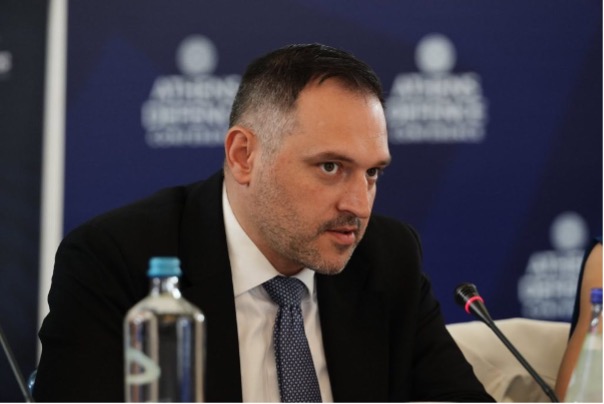
No evidence that Iranian opposition activities in Albania triggered Iran’s 2022 cyberattack, Nufi says.
TIRANA, Albania – Albania’s Defence Minister Ermal Nufi has rejected allegations linking Albanian territory to a recent attack on a Russian vessel off the Libyan coast, while dismissing claims that the activities of Iranian opposition members sheltered in Albania triggered Tehran’s massive cyberattack against the country in 2022.
Speaking to ABC News on Tuesday evening, Nufi addressed two separate security issues that illustrate Albania’s exposure to international geopolitical conflicts, hybrid threats and disinformation campaigns.
The minister categorically denied that Albanian territory had been used to launch the attack against a Russian vessel near Benghazi, Libya, on November 21. Allegations of Albanian involvement, initially circulated by several Turkish online media outlets, were described by Nufi as part of a deliberate disinformation campaign.
Nufi said Ukraine had claimed responsibility for the operation, which involved maritime drone technology that the Albanian Armed Forces do not possess. He also stressed that Albania, as a NATO member, would not undertake a military operation of this nature without coordination with the Alliance.
The incident nevertheless highlights the risks associated with the geographical expansion of the Russian-Ukrainian conflict beyond the immediate theatre of war. For Albania, attempts to associate its territory with military operations against Russia represent a potentially serious security challenge, even when such allegations are unsubstantiated.
Addressing relations with Iran, Nufi said there was no evidence that the activities of the People’s Mojahedin Organization of Iran (MEK), whose members are accommodated in Manza, near Durrës, had triggered the Iranian cyberattack against Albania in 2022.
According to the minister, investigations and inspections conducted by Albanian authorities had found no evidence linking the activities of the camp’s residents to Tehran’s attack. He noted that their average age was over 60 and that the organization operated internationally, with its principal centre in France.
Nufi reiterated the humanitarian nature of Albania’s decision to accommodate the Iranian opposition members. The initial request dated back to 2012, while the arrangement was formalized in 2016, following deadly attacks against members of the organization in Iraq.
The Iranian cyberattack in 2022, which prompted Albania to sever diplomatic relations with Tehran, marked a turning point in the country’s national security environment, demonstrating its vulnerability to unconventional forms of foreign aggression.
Nufi also warned that the escalation of the war in Ukraine and recent tensions along the Estonian-Russian border posed serious threats to regional and international security. He reaffirmed NATO’s defensive mission and highlighted the growing importance of addressing hybrid threats and cyberattacks.
Although the Iranian cyberattack and the allegations surrounding the Russian vessel are fundamentally different, both illustrate how Albania’s security is increasingly affected by conflicts and geopolitical rivalries extending far beyond the Western Balkans.
For a small NATO member with limited national defence capabilities, cybersecurity, intelligence cooperation, institutional resilience and the ability to counter disinformation are becoming increasingly important components of national security.
The principal challenge for Albania is to maintain its international commitments and strategic alignment with NATO while preventing its territory from becoming, or being portrayed as, a platform for military confrontation with third countries.