Kazakhstan’s growing role as a transport and logistics hub connecting Asia and Europe, particularly through its efforts to strengthen the Middle Corridor, could also open possibilities for developing new trade and logistical links with Albanian partners.
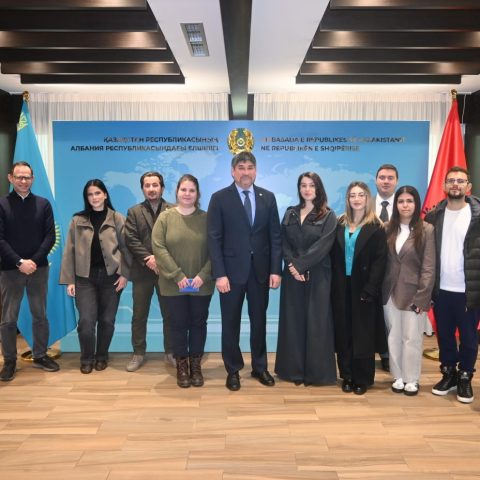
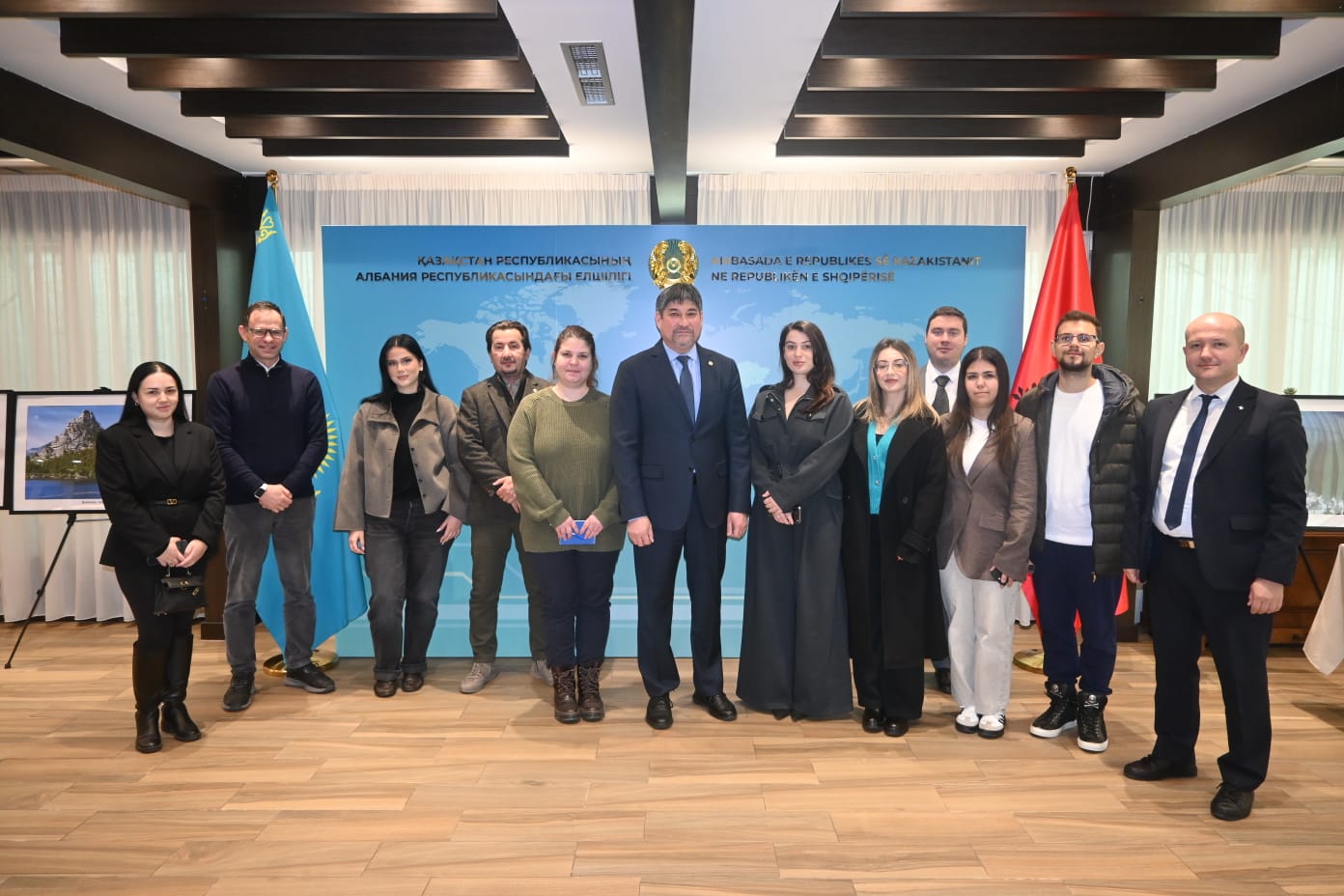
TIRANA, Albania – Kazakhstan’s economic and institutional reforms could create new opportunities for cooperation with Albania in infrastructure, agriculture, transport, education and technology, Kazakh Ambassador Iskander Aisariyev said Tuesday during a conference in Tirana. Organized by the Embassy of Kazakhstan on Nov. 25, the event brought together Albanian academics, experts, and students to discuss the country’s development priorities and prospects for bilateral cooperation.
The roundtable marked Kazakhstan’s upcoming 35th anniversary of independence and focused on priorities outlined in President Kassym-Jomart Tokayev’s Oct. 28 address, titled “Kazakhstan’s Current Priorities in a New Historical Cycle.” Aisariyev presented the country’s modernization agenda, highlighting infrastructure development, energy security, digital transformation, and improvements in public services. A key initiative, “Construction for the People,” envisages building and modernizing roads, railways, schools, hospitals, and municipal utility networks across the country.
These priorities could offer opportunities for Albanian companies, particularly in construction, engineering, agriculture and food processing. Potential areas of cooperation include agricultural technologies, food production and more efficient water management. Kazakhstan’s growing role as a transport and logistics hub connecting Asia and Europe, particularly through its efforts to strengthen the Middle Corridor, could also open possibilities for developing new trade and logistical links with Albanian partners.
Participants also discussed Kazakhstan’s institutional reforms, including its new Constitution, which entered into force on July 1, 2026, and the establishment of a unicameral parliament known as the Kurultai. Albanian international law expert Redion Luli analyzed the relationship between constitutional changes, institutional development and economic growth, also sharing impressions from his visit to Kazakhstan. The structure and powers of the new parliament attracted particular interest among participants, who learned and asked more about the country’s experience with political modernization.
Education, professional development and artificial intelligence were also addressed during the roundtable, including in discussions between Aisariyev and Albanian students studying European law and international relations. The ambassador emphasized the importance of preparing qualified specialists, developing technological skills and improving teachers’ working conditions. Participants highlighted opportunities for closer academic cooperation through professional exchanges and stronger ties between educational institutions. Albania and Kazakhstan mark 33 years of diplomatic relations this year, while Kazakhstan’s embassy in Tirana began operating in 2024, providing a foundation for further economic, institutional, and educational engagement.
Here is Ambassador Iskander Aisariyev’s full speech during the roundtable:
“Allow me to thank you for accepting our invitation to visit the Embassy and discuss the key points of President Kassym-Jomart Tokayev’s Address to the people of Kazakhstan, entitled “Kazakhstan’s Current Priorities in a New Historical Stage”, delivered on 28 October this year.
This Address is not merely an annual policy document. It was delivered at a particularly significant moment: this year, Kazakhstan marks the 35th anniversary of its Independence and is moving towards a new model of public administration in accordance with the revised Constitution, which entered into force on 1 July this year. The President described this phase as the country’s entry into a “new historical stage”, one that calls for discipline, order and social unity.
First, I would like to focus on the economic indicators, which I am confident will be of interest to everyone present. By the end of this year, Kazakhstan’s gross domestic product is expected to approach USD 400 billion, while GDP per capita is projected to exceed USD 19,000, placing our economy 47th in the world. Foreign-exchange and gold reserves, together with the assets of the National Fund, exceed USD 130 billion.
One of the main sections of the Address is devoted to the large-scale “Halyqtyq Qurylys”, or “Building for the People”, programme. This is an unprecedented programme to develop infrastructure across all regions of the country, including roads, airports, railways, hospitals, schools and municipal facilities. Approximately 6.5 trillion tenge, or around USD 14.5 billion, will be allocated from the National Fund for these purposes by 2029. The President proposed declaring next year the “Year of Nationwide Large-Scale Construction”.
I am confident that many Albanian and Balkan companies with considerable experience in construction and engineering will be interested in participating in the implementation of this megaproject.
Of particular interest is the section of the Address devoted to logistics. Kazakhstan is positioning itself not only as a transit country but also as an emerging logistics hub between Asia and Europe: approximately 85 per cent of goods transported from China to Europe already pass through Kazakhstan. The Bakhty–Ayagoz railway line is scheduled to become operational next year and will increase transport capacity towards China by 20 million tonnes. Construction will also continue on the Aral–Caspian highway, which will shorten the Trans-Caspian Route, or Middle Corridor, by almost 1,000 kilometres. I am confident that this area also creates concrete opportunities for Albanian logistics and transport companies.
Particular attention in the Address is devoted to the energy sector. The President has set the goal of achieving a sustainable energy surplus by 2029 through the modernisation of generation capacity, the development of coal-based energy using “clean” technologies, and the expansion of renewable energy sources, particularly solar power. Following the referendum held in the country, a decision was taken to build several nuclear power plants: construction of the “Balkhash” nuclear power plant is due to begin next year, and a cooperation agreement for the “Moyynkum” nuclear power plant is to be signed.
With regard to geology and water resources, the President has also set the task of modernising the geological sector through the use of modern technologies, open data and the attraction of private capital, as well as establishing a national system for the management of critical minerals.
Particular attention is also given to water security. The planned measures include reducing losses in water networks, completing the water tariff reform and establishing a national water information system. These measures are directly linked to improving irrigation efficiency.
As for agriculture, last year the volume of agricultural output in Kazakhstan grew by approximately 6 per cent, reaching 15 trillion tenge, or around USD 33.5 billion. The President called for wider use of artificial intelligence in agriculture, increased domestic production of tractors and combine harvesters, and improved irrigation efficiency, which could increase yields by two to two-and-a-half times. Particular emphasis is also placed on the development of deeper processing, from corn and soybeans to the cotton and textile cluster and the meat industry.
I am confident that here too, given Albania’s extensive experience in agriculture and the food industry, we can identify common ground for practical cooperation of mutual benefit.
A special legal-regime zone, “Alatau City”, is being established, with an investment court operating on the principles of the English common-law system. For small and medium-sized enterprises, which account for around 40 per cent of the country’s GDP, a three-year moratorium on inspections has been proposed, beginning on 1 January 2027, alongside further decriminalisation of offences in the economic sphere.
In the digital sphere, two supercomputers are already operational in Kazakhstan, and a third is expected to become operational by the end of the year. A fibre-optic line has been laid along the bed of the Caspian Sea, and the use of artificial intelligence is expanding across sectors, from agriculture to public administration.
The social agenda occupies an important place in the Address. It includes the construction of eight perinatal hospitals and seven multidisciplinary paediatric hospitals, pay rises for primary healthcare personnel, and an increase in the minimum wage effective from 1 January 2027.
I would also like to briefly address education. The President called for reducing teachers’ administrative burden arising from paper-based reporting and excessive digital documentation, as well as ensuring their protection. Between 2020 and 2023, teachers’ salaries in Kazakhstan doubled. Additional measures include salary supplements based on qualification category, 56 calendar days of paid annual leave, and a health-care allowance provided when annual leave is taken. These measures are intended to enhance the prestige of the teaching profession and strengthen teachers’ social protection.
President Kassym-Jomart Tokayev’s Address is, in essence, a roadmap for Kazakhstan’s development in the years ahead. Many of the priorities it sets out, including logistics, energy, and the investment climate, offer clear points of convergence with the interests of the Republic of Albania.
I am confident that the consistent implementation of these reforms will contribute both to Kazakhstan’s domestic development and to strengthening our bilateral cooperation with Albania.
Thank you for your attention. I will be pleased to hear your comments.”